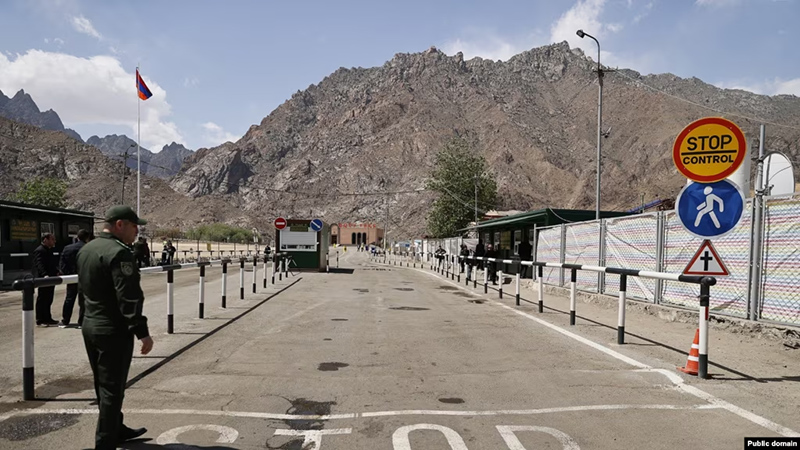
YEREVAN — The conflict between Iran and Israel has disrupted cargo shipments to and from Armenia carried out through Iranian territory, Armenian Economy Minister Gevorg Papoyan said on Monday.
“Unfortunately, I must note that in the last few days of conflict, our economic entities have already encountered some problems,” Papoyan told lawmakers in Yerevan. “Some cargo is stuck in the [Iranian] port of Bandar Abbas, while others are stalled on the roads. So, we are facing issues with exports, and our importers—those who bring goods from Iran or via Iran—are experiencing numerous difficulties as well.”
“We hope that the conflict between the two countries will end, and that we can resume our previously unhindered trade through friendly Iran,” he added.
Finance Minister Vahe Hovhannisyan also warned of the economic costs the ongoing conflict may impose on Armenia. Speaking at a press conference, he confirmed that the Armenian government has not yet held discussions on potential responses to the disruption.
“There are various possible scenarios. Naturally, we also factor in different risk projections in our budget planning. For example, under one such scenario, economic growth might fall to 1.3% instead of the projected 5.1%. As for the escalation between Iran and Israel, there are factors that could have a positive impact on us as well; much depends on the intensity and duration of the escalation,” Hovhannisyan explained.
He recalled that when the Russia-Ukraine conflict began in 2022, Armenia—drawing on lessons from 2014—immediately started planning for adverse outcomes.
“But the reality turned out to be somewhat different, fortunately, and we experienced more positive developments. We’re not rushing to draw conclusions this time either. Our priorities remain unchanged. Naturally, our colleagues at the Ministry of Economy are also addressing logistical supply issues related to the Iran route,” he added.
Among the negative outcomes of the current regional confrontation, Hovhannisyan cited the risk of disruptions, prolonged delays, and increased costs for shipments from Iran.
“If the situation deteriorates to a point where international investors begin to perceive Armenia as a high-risk environment, that could impact interest rates and more. In short, numerous factors are at play here. We need to closely monitor developments and assess what actions are necessary to mitigate potential impacts,” he concluded.
YEREVAN -- Armenian Defense Minister Suren Papikyan has indicated that Czech-made military aircraft may soon…
MOSCOW -- A report prepared by representatives of Russia, Belarus, Kazakhstan, and Kyrgyzstan within the…
WASHINGTON, DC -- U.S.-based businessman and TRIPP+ Fund executive Konstantin Sokolov has outlined plans to…
YEREVAN -- Armenia continues to diversify its foreign economic relations by expanding the presence of…
YEREVAN -- Romanos Petrosyan, acting manager of the Electric Networks of Armenia (ENA), has announced…
BRUSSELS -- On October 16, Hamlet Batikyan, Secretary General of Armenia's Ministry of Defense and…