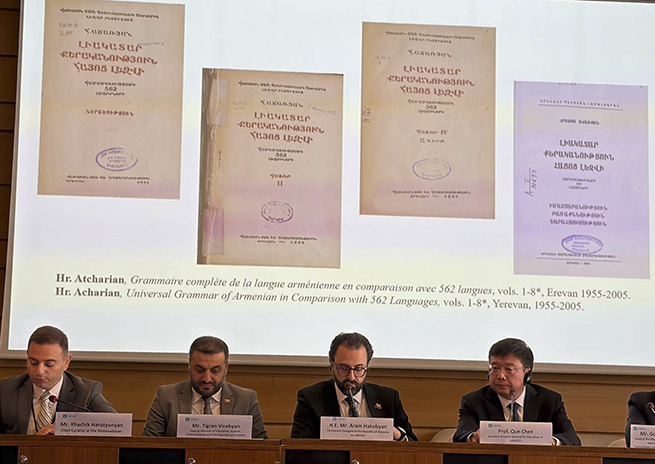
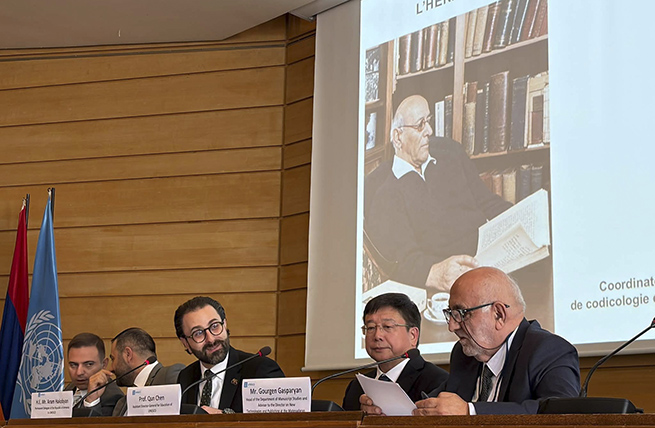
PARIS — A scholarly conference commemorating the 150th anniversary of the birth of distinguished Armenian linguist and scholar Hrachia Acharian was held at UNESCO headquarters, highlighting his contributions to Armenian linguistics and the broader field of language studies.
Organized at the initiative of the Mesrop Mashtots Institute of Ancient Manuscripts (Matenadaran), with the support of Armenia’s Ministry of Education, Science, Culture and Sports, the conference was titled A Life Devoted to Science: Hrachia Acharian.
The event sought to honor Acharian ‘s extensive scholarly legacy, recognize his exceptional contributions to the development of Armenian linguistics, and underscore the significance of his research within the international academic community.
The conference featured presentations examining the scholar’s life, research, and enduring influence on Armenian language studies.
Among the speakers were Khachik Harutyunyan, Chief Curator of the Matenadaran, and Gurgen Gasparyan, adviser to the institute’s director.
Participants emphasized the importance of preserving and advancing Acharian ‘s scholarly heritage, which continues to serve as a valuable resource for linguists, historians, and specialists in Armenian studies.
The gathering also provided an opportunity to reaffirm the international relevance of Acharian ‘s work and its lasting contribution to the study of language, culture, and historical scholarship.
Born in 1876, Hrachia Acharian was one of the most influential figures in modern Armenian linguistics. His pioneering research encompassed Armenian etymology, dialectology, historical linguistics, and the study of personal names.
Among his most significant achievements is the monumental Armenian Etymological Dictionary, a foundational reference work that remains widely consulted by scholars of the Armenian language.
The commemoration at UNESCO headquarters highlighted Acharian ‘s place not only in Armenian intellectual history but also in the wider tradition of comparative and historical linguistics.
MOSCOW — Russian Foreign Ministry spokeswoman Maria Zakharova has characterized Armenian Prime Minister Nikol Pashinyan's…
YEREVAN — A heated confrontation between ruling party and opposition lawmakers in Armenia's National Assembly…
YEREVAN — The 27th Prince Talal International Prize for Human Development award ceremony, organized by…
YEREVAN -- Armenia's National Assembly ratified the framework agreement on strategic cooperation between Armenia and…
YEREVAN -- Armenia has appealed to partner countries to help arrange visits to Armenians held…
YEREVAN -- A tent camp is being established at one of Armenia's military training grounds…