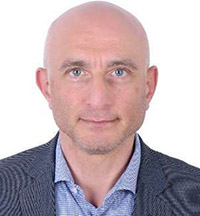
Dr. Tadevos Hovhannisyan (fourth from left) with Armenian EyeCare Project surgical staff and an infant. International training partnerships have helped Armenian specialists develop the skills to perform complex retinal surgery and protect children’s sight. Photo: Armenian EyeCare Project.
By BERGE JOLOLIAN
When doctors in Kyrgyzstan wanted help treating children at risk of blindness, they turned to an Armenian colleague.
In 2024, Dr. Tadevos Hovhannisyan traveled there, examined 40 children and trained three specialists. According to the Armenian EyeCare Project, local doctors subsequently began performing laser procedures themselves.
Years earlier, Hovhannisyan had been the one learning. Specialists from Los Angeles and London helped him develop his skills. In 2015, he performed complex retinal surgery on an eight-week-old infant in Yerevan while a colleague in London watched remotely and provided guidance.
An international connection had become Armenian expertise—knowledge that could help patients at home and be shared abroad.
His story offers an encouraging starting point for thinking about Armenia’s future.
The country is opening more doors. What will it take to turn those openings into greater strength, better lives and more freedom to shape its own future?
More Partners, More Options
For a small country, freedom of choice is something to build.
It grows when a business can reach another market, a university can develop another research partnership, or the armed forces can obtain essential equipment without depending entirely on one supplier.
Heavy dependence works in the opposite direction. When too much rests on one outside power, a disagreement can affect security, trade and energy at the same time. A country may formally retain the right to decide while finding its practical choices painfully narrow.
Armenia’s effort to broaden its relationships deserves recognition.
In May, Yerevan hosted the European Political Community summit and the first EU–Armenia summit. The latter produced a connectivity partnership covering transport, energy and digital links. During President Emmanuel Macron’s visit, Armenia and France also established a strategic partnership, widening cooperation in fields including education, technology, infrastructure and defense.
These are meaningful diplomatic achievements. Their lasting value depends on follow-through: universities able to sustain research partnerships, businesses equipped to enter new markets and public institutions capable of turning agreements into working programs.
Diversification should bring useful capabilities and greater freedom of action without creating another dangerous dependence.
India is an important reminder that this effort reaches beyond a choice between Russia and the West. Armenia can develop productive relationships in several directions, according to its own interests.
No partner will always share Armenia’s priorities. Having more options makes those differences easier to manage.
The Chance to Build at Home
Some international partnerships arrive in football boots.
Juventus, the Italian football club, has established academies in Armenia where children learn through its coaching methods. By the opening of the Avan facility in September, two centers were operating in Yerevan and approximately 700 young players had enrolled. A third facility was under construction in Nor Hachn.
The project also includes opportunities for talented children from Armenia’s regions to train free of charge.
Armenia need not win a World Cup for that to matter.
For a child, access to good coaching, safe facilities and a team can widen the world. For parents, it is another reason to see possibilities for their family’s future at home.
The same connection between opportunity and belonging extends into professional life.
ServiceTitan, founded by Armenian-American entrepreneurs Ara Mahdessian and Vahe Kuzoyan, develops software that helps plumbing, heating, electrical and other service businesses manage their work. It became a publicly traded company on Nasdaq in December 2024—a significant milestone for a business inspired by the practical needs of the founders’ families.
Its Yerevan team develops and improves products used by customers abroad. A research agreement with the American University of Armenia was designed to help engineering students apply artificial intelligence and machine learning to real business problems.
For a young Armenian, the significance is straightforward: an international career need not always require leaving Armenia.
That possibility depends on education, demanding professional work and opportunities to keep learning. Synopsys’s longstanding engagement with Armenian engineering education, alongside institutions such as TUMO and COAF, shows how different organizations can contribute to that progression.
The next stage increasingly involves computing power.
Firebird, an AI infrastructure company, opened its Hrazdan facility in August, using NVIDIA computing technology and Dell systems. Such an “AI factory” provides the powerful computers needed to develop and run artificial intelligence applications.
The opening is an achievement. Its larger expansion plans remain work ahead.
NVIDIA’s Armenian-American vice president, Rev Lebaredian, has been a prominent participant in Armenia’s technology relationships. His involvement illustrates the value of professional connections that link Armenian talent with major international companies. The broader opportunity is to make advanced tools available to researchers and businesses developing their own work in Armenia.
Other possibilities require equally careful description. In an October interview, Prime Minister Nikol Pashinyan said Amazon was prepared to invest if Armenia could provide the reliable, round-the-clock electricity it required. That is reported conditional interest, not an announced operating facility or a completed investment.
The distinction matters. Interest becomes investment only when the practical conditions exist.
Reliable electricity, capable engineers, predictable rules and accountable institutions may receive less attention than a major company’s name. They determine whether the opportunity becomes real.
The Ability to Protect That Future
A country must also be able to protect what its people are building.
Armenia’s defense diversification therefore deserves attention beyond the announcement of a weapons purchase. A capable military needs trained personnel, effective leadership, reliable maintenance and institutions that preserve knowledge as people move between assignments.
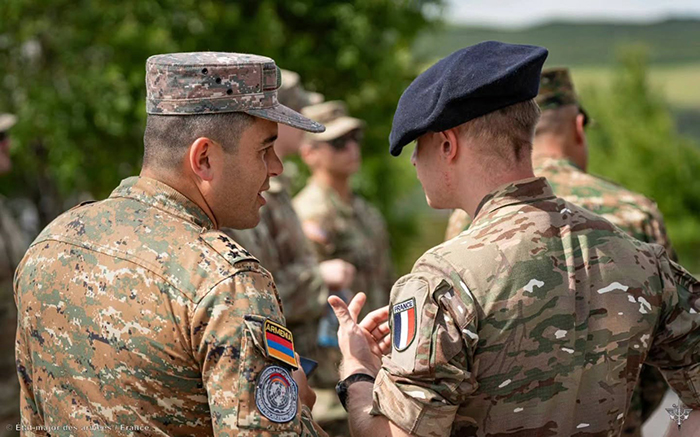
This summer, Armenian servicemen completed a course with a British military training team at the Vazgen Sargsyan Military Academy. Some earned instructor qualifications. That matters because a trained instructor can pass knowledge to many more soldiers.
June’s Eagle Partner exercise brought Armenian personnel together with American, French and Greek forces. France and Greece participated for the first time, contributing to an exercise focused on peacekeeping preparation and the ability of different forces to work together.
France’s wider cooperation includes advice, training and equipment. India’s contribution extends from military systems to education and technical expertise. Cooperation with Poland offers opportunities in military education and the modernization of equipment, drawing on its experience with Soviet-origin systems.
These relationships must work together. Armenia needs trained crews, maintenance and reliable supplies to operate and sustain equipment from different sources.
More suppliers can reduce vulnerability. Poorly integrated systems can create new difficulties. The measure of success is what Armenian forces become able to do reliably themselves.
Training exercises do not constitute a defense guarantee. Nor does a friendly capital automatically become an ally committed to intervene in a crisis.
Their value lies in the capabilities Armenia develops, the relationships it can sustain and the dependencies it can reduce. These are practical gains worth pursuing—and assessing honestly.
Making Peace Work
A family deciding where to live and a business considering expansion need confidence in the future. Peace allows them to plan beyond the next crisis.
This gives Armenia’s diplomacy a daily, human purpose.
The agreement initialed in Washington in August 2025 created an important basis for further work. Initialing a text, however, is different from signing, ratifying and implementing it. A durable settlement must be judged by what happens beyond the negotiating table.
The same applies to transport.
Crossroads of Peace and TRIPP should be assessed by whether they provide dependable connections, create economic opportunities and preserve Armenia’s sovereignty and jurisdiction.
Their value would extend beyond collecting fees from passing traffic. An Armenian manufacturer could reach customers more easily. A business could obtain equipment through another route. Communities could benefit from investment and employment.
Those possibilities require workable arrangements, infrastructure and confidence that agreed rules will be respected.
Diplomacy can create time and opportunity. Armenia must use both.
A stronger economy helps sustain defense. A capable military improves Armenia’s ability to negotiate. Effective diplomacy can reduce the likelihood of war and create space to strengthen both.
This is also how difficult compromises should be discussed.
A government must weigh what it can secure, what it risks and which alternatives it can sustain. Saying no carries greater weight when there is the capacity to support that refusal.
Building that capacity can give Armenia more influence over the terms it faces tomorrow.
None of this excuses a poorly negotiated concession. Citizens deserve clear explanations of what is being exchanged, what safeguards exist and why the government believes an agreement improves their security.
The standard should be the same for proposals to reject an agreement: how would the alternative protect Armenia and produce a better outcome?
Keeping Our Judgment Under Pressure
This work takes place in a difficult neighborhood.
Azerbaijan’s hostile rhetoric, territorial narratives and objections to Armenia’s defense cooperation give Armenians legitimate reasons for concern. Diplomatic praise from abroad does not make those concerns disappear.
Nor should every provocation be allowed to determine Armenia’s next move.
Pressure can do damage before a shot is fired. It can deepen mistrust, encourage despair and turn political disagreement into a conviction that every available course is betrayal.
Armenia needs the discipline to document threats, strengthen its defenses, seek international support and continue useful negotiations. It must retain the ability to decide which response serves its interests.
For the Diaspora, this means directing concern toward effective action.
Ask elected representatives to scrutinize threats against Armenia. Support independent monitoring and the rights of Armenian prisoners and displaced families. Help ensure that international engagement with Azerbaijan includes expectations of conduct, with consequences when commitments are violated.
An October 5 letter to Secretary of State Marco Rubio offers a practical example. Signed by 101 members of Congress from both parties, it questions the continued waiver of Section 907, which restricts U.S. assistance to Azerbaijan’s government. The lawmakers urge withholding military assistance unless Azerbaijan takes meaningful steps toward releasing Armenian prisoners and withdrawing its forces from sovereign Armenian territory. Such advocacy supports diplomacy while pressing for results that improve Armenia’s security.
We should bring the same focus on practical results to our disagreements with one another. Treating every diplomatic initiative as surrender, or every criticism of the government as disloyalty, makes that harder.
Citizens do not need a complete foreign-policy program to question their government. Independent journalism, opposition and public scrutiny are essential. Those advocating a major change of direction, however, make a stronger case when they explain the costs and practical alternatives.
The government also owes the public more than assurances that it knows best.
It should explain difficult choices with evidence, acknowledge uncertainty and recognize the grief and historical experience that shape Armenian reactions. Careless words about Artsakh, the Genocide, the Church or the Diaspora can damage trust that useful policies need.
A responsible discussion can recognize danger and progress at the same time.
Armenia can face a threatening neighbor while improving its own capabilities. A government can make mistakes while pursuing relationships that benefit the country. Recognizing those benefits leaves ample room to demand correction elsewhere.
A Common Purpose
There is room in this work for Armenians who disagree strongly about politics.
A doctor abroad can support a hospital in Armenia while disliking the prime minister. An engineer can mentor colleagues while criticizing a government decision. A business owner can help an Armenian company reach new customers without joining a political camp.
Useful cooperation should become ordinary.
The Diaspora brings professional knowledge, institutions, capital and relationships built across generations. Armenia brings its own expertise, creativity and the experience of people who live with the consequences of national decisions.
Both sides benefit when they listen.
Government has a particular responsibility because it exercises public power. Proposals deserve serious consideration, rules should be predictable, and commitments should survive a change of minister. Donors and investors need clear accounts of results. A reasoned refusal shows more respect than silence.
The Republic should also take a lasting interest in Armenian life abroad. Community schools, Western Armenian education, archives and cultural institutions have value beyond their immediate contribution to a government program.
Partnership grows stronger when respect travels in both directions.
Government announcements and accusations against the government deserve the same scrutiny. Recognizing an achievement does not endorse an administration’s entire record. Holding it accountable for failure does not diminish our commitment to the Republic.
Useful programs should serve Armenia through many governments.
The question guiding this effort remains:
And the necessary follow-up:
We should distinguish what has been achieved, what is underway and what remains a promise.
A trained instructor, an Armenian team developing software and an operating computing facility are identifiable achievements. An investment discussion is an opening. Its value will become clearer as commitments turn into working projects and benefits reach people.
This approach allows us to welcome progress without surrendering judgment.
Hovhannisyan’s journey offers a simple illustration. He learned from colleagues abroad, applied that knowledge in Armenia and later helped others acquire it. International cooperation became a capability he could use and share.
More Armenians should have the opportunity to follow that path—in medicine, engineering, education, business and public service.
The children training on a football pitch need not yet think about sovereignty. They should be able to think about their next pass, their next lesson and what they might become.
Our task is to help preserve the country in which those possibilities can grow.
The freedom to choose ultimately means the freedom to learn, work, raise a family, elect a government and help shape the future of one’s own home.
That is a future worth building together.
Berge Jololian is an Armenian-American IT and cybersecurity professional based in Yerevan, Armenia, and Watertown, Massachusetts. His writing examines Armenian statehood and sovereignty, relations between the Republic and the Diaspora, regional security, and the strategic choices facing small states.
By KRIKOR KHODANIAN The 23rd Congress of the Social Democratic Hunchakian Party (SDHP) was recently…
Tekeyan Cultural Association Pasadena–Glendale Chapter and Armenian Art Gallery Present a Collective Exhibition of Contemporary…
TURKMENBASHI - Armenian Prime Minister Nikol Pashinyan has declared that peace between Armenia and Azerbaijan…
TURKMENBASHI - - Armenian Prime Minister Nikol Pashinyan and Iranian President Masoud Pezeshkian met in…
STRASBOURG -- The European Parliament has adopted a resolution calling on Azerbaijan to immediately release…
YEREVAN -- The Armenian National Assembly has announced the composition of a parliamentary commission established…