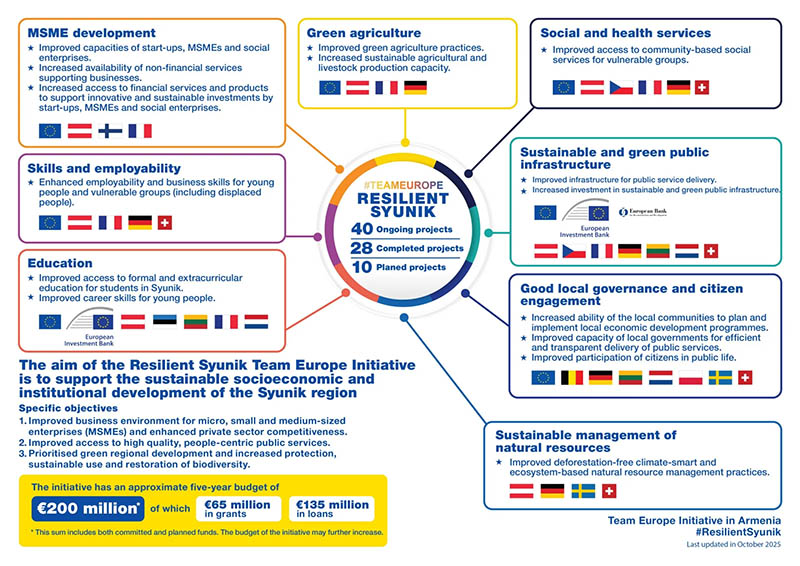
SYUNIK — Alongside the Armenian-American TRIPP project, the European Union is also making major investments in Armenia’s Syunik Province. Through the Resilient Syunik Team Europe Initiative, launched in 2023, the EU, its member states, Switzerland and European financial institutions have mobilized €258 million for projects ranging from irrigation and drinking-water infrastructure to social services, business development and the preservation of cultural heritage. EU for Armenia
“I want to tell the people of Syunik that the European Union stands by you and supports your efforts,” said Vassilis Maragos, Head of the EU Delegation to Armenia. “The Armenian people know how important Syunik is. It is a very important region for Armenia and plays a major role in maintaining the country’s resilience, sovereignty and territorial integrity.”
The initiative’s overall mobilized investment has now reached €258 million, consisting of both loans and grants. EU for Armenia
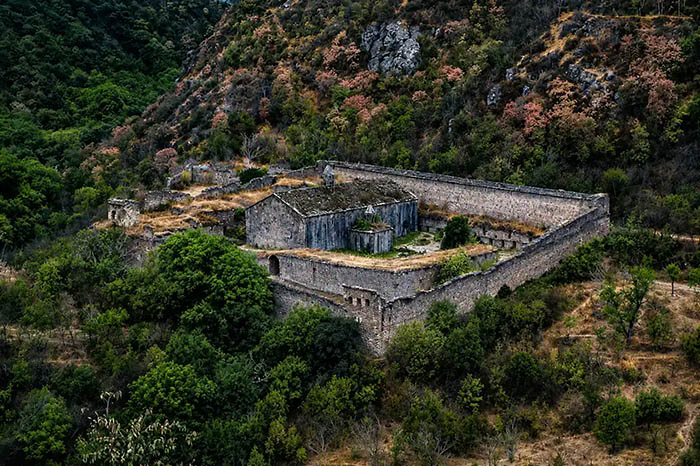
Among the projects is the rehabilitation of the 36-kilometer Spandaryan irrigation canal, which is expected to provide irrigation for more than 2,000 hectares of agricultural land. With French support, archaeological excavations are being conducted at the 17th-century Great Hermitage of Tatev in preparation for restoration work. EU-backed programs are also providing accommodation and care for elderly people requiring special assistance, while Armenian producers and agricultural processors are receiving infrastructure and equipment to expand their operations.
Overall, around 80 projects have either been implemented or are planned under the initiative, and its budget could expand further.
“Investing in this region is a shared and highly important objective of the European Union and the Armenian government,” Maragos said.
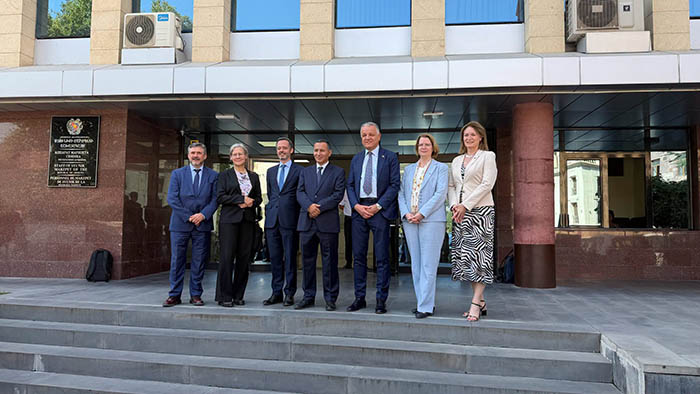
The EU ambassador and the ambassadors of several member states visited Syunik this week to review the projects on the ground. The delegation toured projects involving irrigation, cultural heritage, elderly care, drinking-water infrastructure and local businesses. EU for Armenia
“We are continuously adding new projects to this initiative,” Maragos said.
EU Expands Regional Connectivity Investments
This summer, European Commission President Ursula von der Leyen, during visits to Baku and Yerevan, announced up to €200 million in new investment under the EU’s Global Gateway program for the development of transport, energy and information-technology connectivity in the South Caucasus.
At the first Armenia-EU summit in Yerevan in May, the two sides also signed a Connectivity Partnership, which Brussels says is aligned with Armenia’s Crossroads of Peace initiative. The EU’s broader Global Gateway investment portfolio in Armenia has grown to more than €2.5 billion in expected mobilized investment, including major transport, energy and water-management projects. Enlargement and Eastern Neighborhood
The specific projects to be implemented under the new connectivity agenda have not yet been determined, according to Maragos.
“The European Union supports the Crossroads of Peace initiative. The details also need to be discussed with the neighboring countries, and we need to determine what the specific projects will be,” he said.
Several infrastructure projects agreed upon earlier are already moving forward. The EU is co-financing the construction of a new Armenia-Iran border crossing, while Maragos also highlighted European investment in the Sisian-Kajaran section of Armenia’s North-South Road Corridor.
Although construction has yet to begin on what specialists consider one of the most technically challenging sections of the highway, Armenian authorities have said they plan to complete the approximately 60-kilometer stretch by 2031.
About two years ago, the Armenian government signed a €236 million loan agreement with the European Investment Bank to co-finance the project. The EIB has described the Sisian-Kajaran road as a major connectivity project intended to provide safer and faster transport, improve access to domestic and international markets, and strengthen Syunik’s economic development. European External Action Service
Yerevan has also reached agreements for €236 million each in financing from the European Bank for Reconstruction and Development and the Asian Development Bank.
“This project will bring Kapan and Meghri much closer to Yerevan and to the market,” Maragos emphasized.
Brussels has also expressed readiness to support the TRIPP project itself. According to the EU delegation chief, European officials are currently discussing with Yerevan and Washington what opportunities may exist for EU participation.
Sunday attendance up 59% or 591. Young women 11% of total. Social media views over…
YEREVAN — Armenian Foreign Minister Ararat Mirzoyan has dismissed reports suggesting significant Iranian concerns over…
YEREVAN — Heads of state, senior government officials, and representatives of international organizations have gathered…
YEREVAN — Armenian Prime Minister Nikol Pashinyan met with Iranian President Masoud Pezeshkian on the…
YEREVAN — Armenian Security Council Secretary Alen Simonyan said Armenia and Azerbaijan are discussing the…
WASHINGTON, D.C. — The Armenian Council of America (ACA) joined U.S. government officials, diplomats, and…