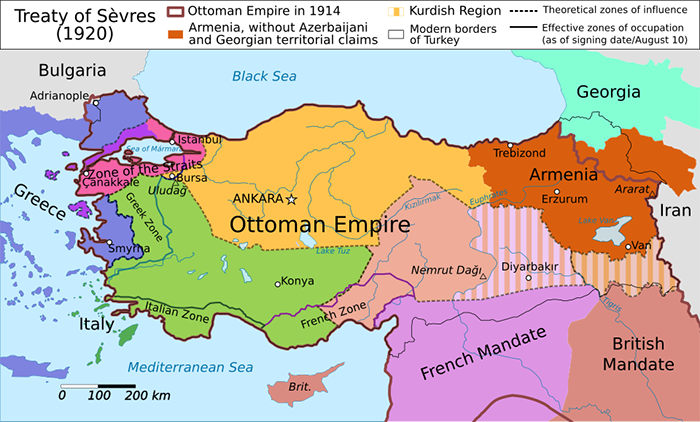
Signing of Treaty of Sèvres
By Eng. HAMBERSOM AGHBASHIAN
Treaty of Sèvres
By 1918, Allied troops had captured all the Empire’s remaining territories outside of Anatolia, and On October 30, 1918, the Ottomans signed an armistice with the Allied Powers. Subsequently, on August 10, 1920, the Treaty of Sèvres was signed by the Ottoman Empire, France, Britain, Italy, and several smaller Allied nations, officially marking the end of the empire and the Turkish state.
The news of the Treaty sparked a revolution in Turkey and initiated the Turkish War of Independence. The war concluded in 1923 with the signing of the Treaty of Lausanne, which established much of the framework for the modern Middle East.
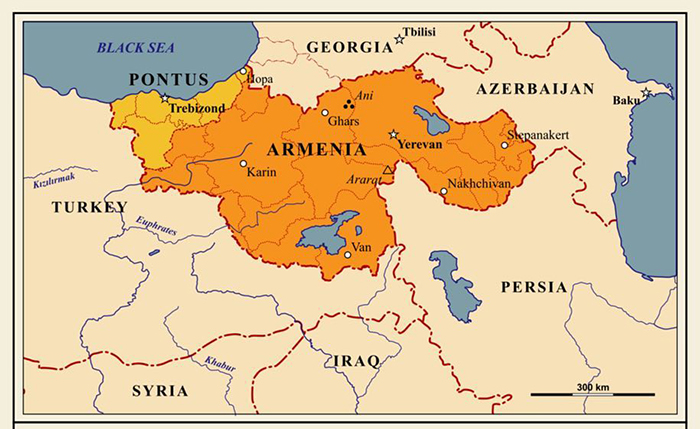
Wilsonian Map of Armenia:
This map depicts President Woodrow Wilson’s 1920 proposal for a U.S. protectorate over Armenia, often referred to as Wilson’s Armenia. Despite Wilson’s persistence and efforts, the U.S. Congress ultimately rejected his proposal, voting 52 to 23 against it. This decision left the Armenians and their territories vulnerable to Turkish nationalists led by Atatürk. Consequently, Western Armenia was entirely lost, and Eastern Armenia eventually fell under Soviet control. If Congress had accepted Wilson’s proposal, the course of history might have been very different.
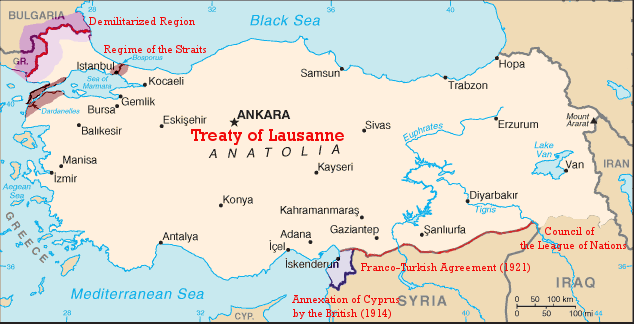
Treaty of Lausanne
The Treaty of Lausanne was signed on July 24, 1923, in Lausanne, Switzerland. It was the final treaty to end World War I and to establish the modern Republic of Turkey.
The Treaty of Lausanne was signed between the British Empire, France, Italy, Japan, Greece, Romania, the Serb-Croat-Slovene State, and Turkey. The Government of the Grand National Assembly of Turkey in Ankara, representing Atatürk’s government, was represented by:
– Ismet Pasha, Minister for Foreign Affairs and Deputy for Adrianople.
– Dr. Riza Nour Bey, Minister for Health and Public Assistance and Deputy for Sinope.
– Hassan Bey, former Minister and Deputy for Trebizond.
The Treaty of Lausanne replaced the earlier Treaty of Sèvres, which was signed in 1920. While the Treaty of Sèvres included provisions for an independent Armenian state in Western Armenia, the Treaty of Lausanne made no mention of Armenia or Armenian rights.
Unlike the Treaty of Sèvres, which had addressed Armenian independence, the Treaty of Lausanne made no mention of Armenia or the Armenians. This was a crushing blow to Armenian hopes for self-determination and recognition of their ancestral lands in Eastern Anatolia.
An annex to the treaty issued a declaration of amnesty for crimes committed between 1914 and 1922. This effectively granted immunity to those responsible for the Armenian Genocide, ending any international efforts to prosecute Ottoman war criminals.
By not addressing the atrocities committed against the Armenian population, the treaty codified impunity for the crimes of the genocide. Historians note that this action effectively made the Armenian Genocide politically inconsequential in the eyes of the international community.
While the treaty included articles on the protection of non-Muslim minorities (Articles 37 to 45), these provisions failed to adequately safeguard the remaining Armenians. These protections were often violated, leading many of the remaining Armenians and other minorities to leave Turkey.
Armenian representatives lobbied at the Lausanne Conference, but the Allied Powers, seeking to normalize relations with the new Turkish state, ultimately abandoned their pledges to the Armenians. The signing of the treaty is often described as “the burial of the Armenian Cause”.
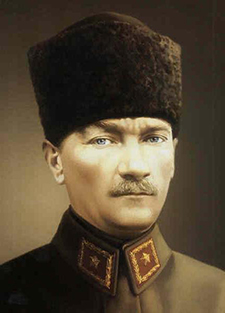
Mustafa Kemal Atatürk, Founder of the Modern Turkish Republic
With the deteriorating conditions of the army and the collapse of morale, nationalist forces in Anatolia began to organize their ranks to prepare for a new phase of political and military struggle.
Mustafa Kemal Atatürk, the leader of the Turkish National Movement and Commander-in-Chief of the Turkish Army during the War of Independence, was born in 1881 and later became the first president of the Turkish Republic. He began his military career as an army officer, achieving the rank of captain in 1907 and eventually rising to the rank of commander of the Third Army. In 1909, he joined the Committee of Union and Progress. Atatürk participated in the war against Italy and returned to Istanbul following the Ottoman defeat. The Balkan War subsequently broke out, leading to the Ottoman Empire’s defeat in 1913, the loss of most of its European territories—namely Bulgaria, Greece, Montenegro, and Serbia—and the declaration of the Albanian state. In 1918, he fought in the Battle of Gallipoli (Dardanelles). On April 23, 1920, the first day of the Turkish Grand National Assembly, Atatürk began leading the fight against foreign presence in Turkey. He was elected as the first Speaker of Parliament and served as Prime Minister. After the War of Independence, the Treaty of Lausanne was signed on June 24, 1923, between representatives of the Turkish National Assembly and representatives from the British Empire, Italy, Japan, Greece, Romania, Serbia, Croatia, Slovenia, and France.
After leading the Turkish National Movement and fighting in the Turkish War of Independence, Atatürk abolished the Ottoman sultanate and declared the Republic of Turkey in 1923. The National Assembly elected him as the first president, a position he held until his death in 1938.
* * *
Seizure of Armenian Property in Turkey
The confiscation of Armenian property began with the Hamidi massacres in the mid-1890s and reached its peak during the Armenian Genocide, with laws passed by the Ottoman government during the Genocide, resulting in widespread confiscation of Armenian property. The Turkish government continued systematically confiscating Armenian property until 1955 and 1974.
Between 1915 and 1917, the government declared Armenian assets to be “abandoned” and transferred them to the state. Laws such as the Law of Abandoned Properties (Emval-i Metruke) facilitated the confiscation of vast amounts of Armenian wealth, which was subsequently used to fund state institutions and resettle Muslim populations. In January 1916, the Ottoman Minister of Trade and Agriculture issued a decree requiring all financial institutions operating within the Ottoman Empire to surrender Armenian financial assets to the government. This dispossession was a systematic component of the genocide policy, aimed at demographic redesign and providing financial resources for the emerging Turkish Republic. The practice of confiscation continued into the 20th century, with some properties remaining under state control or being reallocated to refugees and migrants.
Historians argue that the mass confiscation of Armenian property significantly shaped the economic foundation of the Turkish Republic, as the Turkish economy was bolstered by Armenian capital. This process contributed to the development of a new Turkish bourgeoisie and a middle class.
FRESNO -- Journal of the Society for Armenian Studies (JSAS) Editors-in-Chief Houri Berberian (Chancellor’s Professor…
By BERGE JOLOLIAN A recent exchange between Armenia's Security Council Secretary Alen Simonyan and Ara…
BAKU -- Tensions have emerged between Azerbaijan and Turkey over restrictions on Islamic headscarves in…
WARSAW -- Armenian Foreign Minister Ararat Mirzoyan met with Ukrainian Foreign Minister Andrii Sybiha on…
YEREVAN -- Armenia is undergoing a significant transformation in its migration patterns, shifting from a…
WATERTOWN, MA--The Armenian Museum of America (AMoA) is pleased to announce the appointment of Sarah…