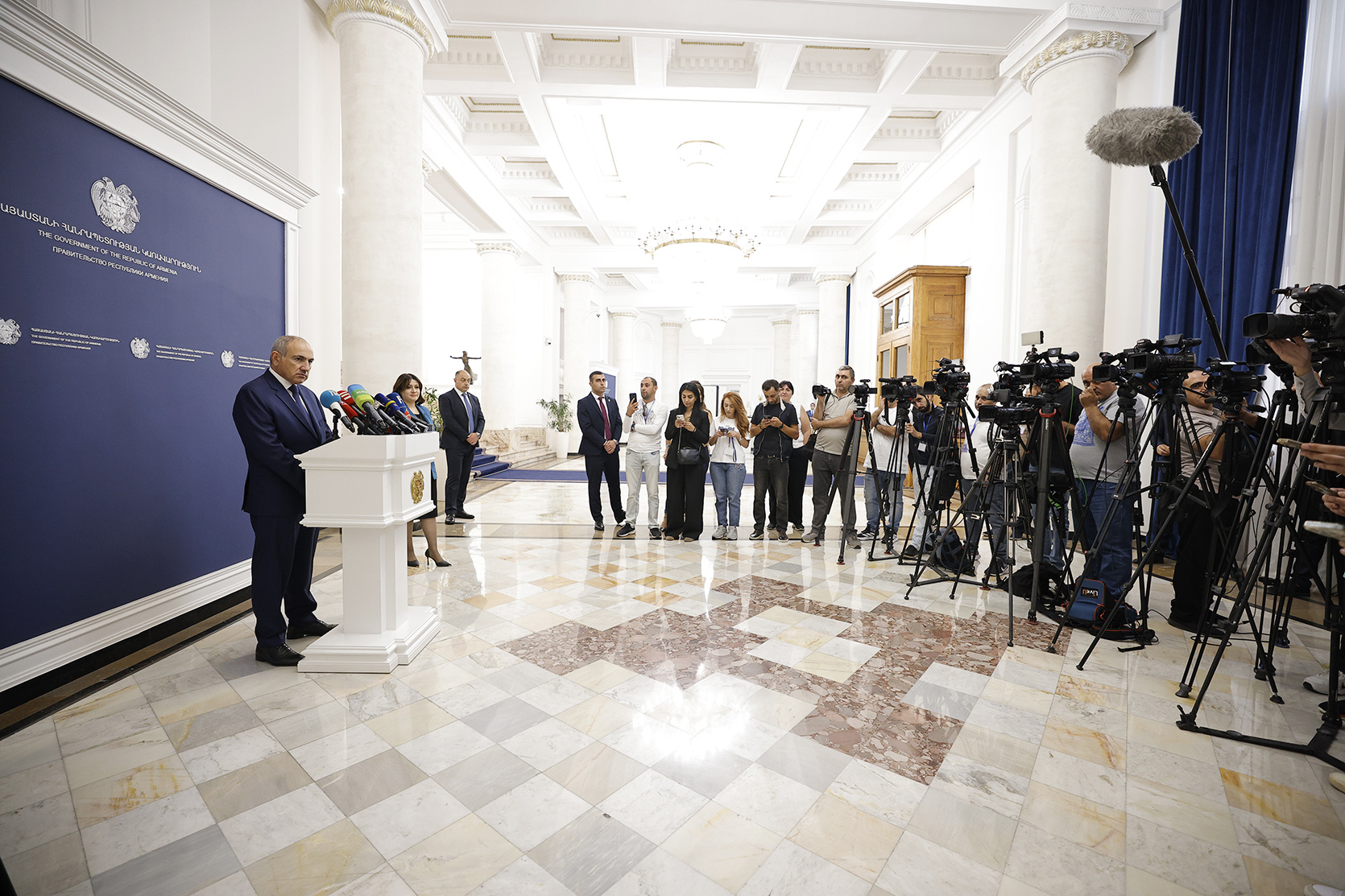
YEREVAN — Prime Minister Nikol Pashinyan announced that Armenia and the Islamic Republic of Iran have reached agreements and plans to deepen their partnership and economic cooperation. Speaking at a press briefing, he emphasized that as part of regional opening efforts, Armenia will soon have a railway connection with Iran, which he described as a highly significant logistics corridor.
“This railway will greatly expand opportunities for economic cooperation,” Pashinyan said, adding that construction of the North–South Highway is also progressing at a steady pace. He noted that the line will not only strengthen connectivity between Armenia and Iran but also increase transit potential with Azerbaijan, as the route will pass through Armenia, the Nakhichevan Autonomous Republic, and Iran.
“Our program is not—and cannot be—to increase Armenia’s and Iran’s transit role without also expanding Nakhichevan’s. In the case of a railway, such separation is impossible. Framing the issue that way is not correct, especially in the context of peace and regional cooperation. Work in this direction continues,” he explained.
Pashinyan also addressed questions about the recent decision to remove the image of Mount Ararat from Armenia’s passport entry and exit stamps. Asked whether this decision was made under Turkish pressure following the visit of Turkey’s special representative Serdar Kılıç to Yerevan, Pashinyan dismissed such claims.
“The issue of the stamp had been under discussion many months earlier, at a time when there was not even a theoretical possibility or agreement regarding the Turkish envoy’s visit. Such a matter has never been and cannot be a subject of Armenia–Turkey negotiations,” Pashinyan stated.
He stressed that the decision was guided by Armenia’s security strategy, where the principle of legality is paramount. “When you cross the street, do you use the crosswalk because someone threatened or intimidated you? No—you do it because you want to live by rules and order. We want Armenia to be a responsible international partner and to live according to internationally accepted norms. We lead Armenia with that logic and with a strategy of legality.”
Pashinyan further pointed out that the stamp itself had no consistent political meaning. “If the stamp didn’t exist before 2004, what did its absence mean then? And if it appeared in 2004, what did its introduction mean? Perhaps officials at the time were trying to resolve questions of legality in their own way,” he said.
Concluding, the Prime Minister emphasized that legality is essential both internationally and domestically. “Let me be blunt: when a government has not been elected by the people as defined by the Constitution, it tries to find new sources of legitimacy—by placing images on stamps, attaching symbols elsewhere, or shifting perceptions and responsibility outside Armenia—to cover up the fact that there is no legitimate authority within the country. Our strategy is different: we are building a lawful and accountable state,” Pashinyan said.
STRASBOURG -- European Commissioner for Enlargement Marta Kos has reaffirmed the European Union's readiness to…
YEREVAN -- Armenia recorded a significant increase in tourist arrivals in September 2026, with the…
YEREVAN -- Prime Minister Nikol Pashinyan has said that Amazon is prepared to make investments…
YEREVAN -- Armenian Foreign Minister Ararat Mirzoyan has said that Iranian officials are satisfied with…
NEW YORK — The Children of Armenia Fund (COAF) today announced the launch of The…
WATERTOWN, MA--The Armenian Museum of America is pleased to announce the opening of Beyond the…