By H. AGHBASHIAN
Armenia: From an Independent Kingdom to a Divided State
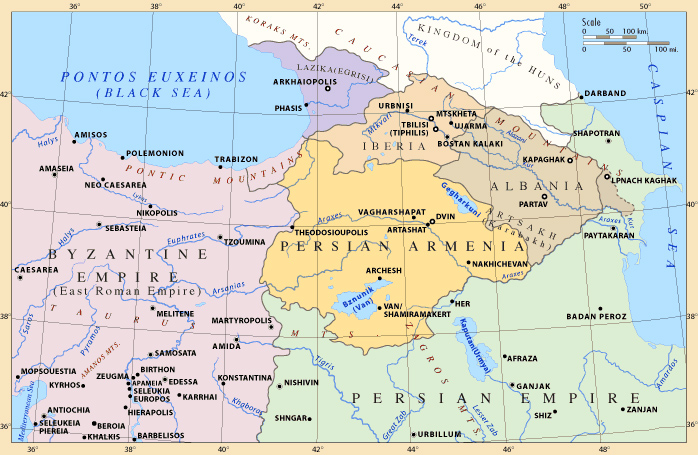
Due to its geographical location, Armenia became a battleground between the Sassanian Empire to the east and the Byzantine Empire to the west. In 378, Armenia was divided: the Byzantine Empire (Eastern Roman) took control of Western Armenia, while the Sassanian (Persian) Empire occupied Eastern Armenia.
After the fall of the Armenian Arshakuni dynasty in 428, Eastern Armenia was annexed by the Sassanian Empire, though it remained nominally under the title of the Kingdom of Armenia. Meanwhile, the Byzantine Empire occupied Western Armenia, which came to be known as Armenia Minor.
After 636, the autonomous Principality of Armenia emerged within the Islamic Caliphate. Armenian lands, including those previously under Byzantine rule, were unified under the emirate, which was governed by a Prince of Armenia recognized by both the Caliph and the Byzantine Emperor. Muslim conquests took place during the reign of Caliph Umar ibn al-Khattab in 642 and later under Abd al-Malik ibn Marwan in 744. By the mid-7th century, Armenia became a province of the Umayyad and later Abbasid Caliphates. Although Armenia occasionally retained a degree of autonomy, Armenians were taxed as non-Muslims (dhimmi) through the payment of jizya.
The Armenians regained their independence with the weakening of Arab power during the reign of the Bagratid (Bagradonian) dynasty. King Ashot I established the Kingdom of Armenia in 884, with Ani as its capital.
In 1045, Armenia fell once more to the Byzantines. Following this, Armenians moved eastward and established the Kingdom of Cilicia (1080–1375). In 1071, the Seljuk Turks defeated the Byzantines in the Battle of Manzikert, bringing most of Armenia under Seljuk rule. By the mid-13th century, Armenia was conquered by the Mongols, and later by the Turkmen confederations of the Kara Koyunlu and Aq Koyunlu. In the 16th century, Armenia was divided between two Islamic empires: Safavid Persia (east) and the Ottoman Empire (west).
The Final Division of Armenia
The division of Armenia was formalized by the Treaty of Amasya in 1555 and the Treaty of Zuhab in 1639.
Western Armenia
Western Armenia was finally annexed to the Ottoman Empire in 1639. The provinces of Van, Erzurum, Mamuretul Aziz, Bitlis, Diyarbakir, and Sivas became part of the empire. Ottoman incursions into Western Armenia had occurred gradually over the 15th and 16th centuries, culminating in the final annexation.
Eastern Armenia
Eastern Armenia was annexed by the Safavid (Persian) Empire in 1639 and remained under Persian control until 1828. Following the Treaty of Turkmenchay in 1828, Eastern Armenia was transferred from the Persian Qajar Empire to the Russian Empire.
At the beginning of the 20th century, Armenia briefly declared independence before being annexed by the Soviet Union in the late 1920s. On September 21, 1991, following the collapse of the Soviet Union, Armenia regained its independence as the Republic of Armenia, the nation we know today.
Next: Western Armenia under Ottoman Rule
TURKMENBASHI - Armenian Prime Minister Nikol Pashinyan has declared that peace between Armenia and Azerbaijan…
TURKMENBASHI - - Armenian Prime Minister Nikol Pashinyan and Iranian President Masoud Pezeshkian met in…
STRASBOURG -- The European Parliament has adopted a resolution calling on Azerbaijan to immediately release…
YEREVAN -- The Armenian National Assembly has announced the composition of a parliamentary commission established…
YEREVAN -- Armenia's Prosecutor's Office has submitted an indictment against former Police Troops Commander Grigor…
YEREVAN -- Samvel Karapetyan, leader of the opposition Strong Armenia Party, has reiterated his determination…