YEREVAN – A new nationwide poll in Armenia by the International Republican Institute’s (IRI) Center for Insights in Survey Research rates political instability and the return of prisoners of war as the top concerns for Armenians. Armenians also expressed deep skepticism for COVID-19 vaccines while voter enthusiasm for snap elections on June 20th remains high.
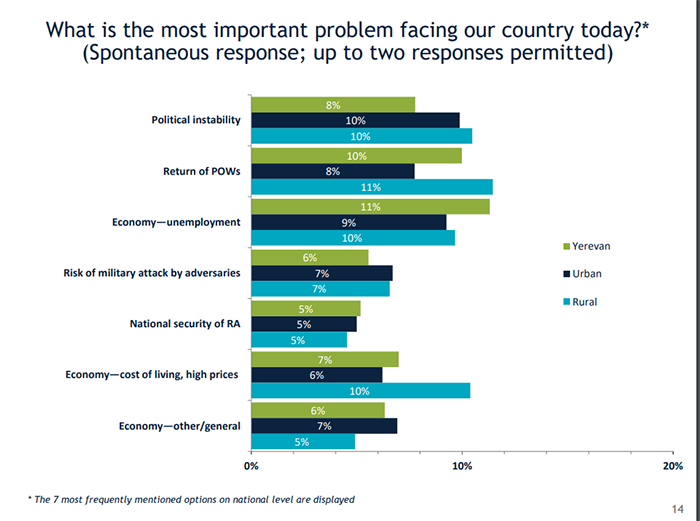
When asked about most important problems facing the country, the largest segments of Armenians mention political instability (12%), the return of prisoners of war (11%) and unemployment (11%).
The survey shows that an overwhelming majority of people do not wish to receive the COVID-19 vaccine. Nationwide, 71% of Armenians state that they would not take the vaccine even if it were readily available. When asked about their opinion of various politicians, Armenians gave their most favorable ratings to Prime Minister Nikol Pashinyan (45%) and Speaker of the Parliament Ararat Mirzoyan (40%).
“After the election in June, the new government will have to work hard to allay any fears the Armenian people have regarding vaccines for the recent pandemic,” said Stephen Nix, Director of IRI’s Eurasia Division. “They will also need to show a sustained commitment on the prisoners of war issue and improving the economy.”
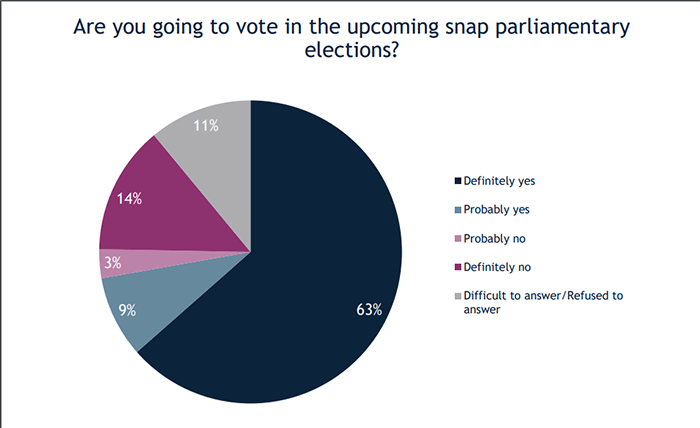
Armenians also express strong enthusiasm for the elections in June. A strong majority (72%) say that they will definitely or probably cast a ballot.
“It’s very reassuring to know that an overwhelming majority of Armenians plan to vote,” said Nix. “That is very important right before an election.”
The survey was conducted on behalf of International Republican Institute’s Center for Insights in Survey Research by Caucasus Research Resource Center (CRRC) – Armenia Foundation. Data was collected throughout Armenia between April 8 and May 4, 2021 through phone interviews, with respondents selected by automatized random digit dialing (RDD) probability sampling of mobile phone numbers. The national sample consisted of 1,203 permanent residents of Armenia aged 18 and older, plus an additional 299 oversample respondents in specific regions. It is representative of the population aged 18 and older with access to a mobile phone. The margin of error does not exceed plus or minus 2.5 points for the full sample. The response rate was 37 %. The Survey was funded by the U.S. Agency for International Development.
MALTA — Armenia claimed first place at the Junior Eurovision Song Contest 2026 on October…
GLENDALE -- The Consulate General of the Republic of Armenia in Los Angeles has issued…
By BERGE JOLOLIAN A confidence-building summit is an unusual place to taunt prisoners. Yet at…
ROTTERDAM -- Armenian gymnast Hamlet Manukyan has been crowned world champion in the pommel horse…
Sunday attendance up 62% or 629. Young women 12% of total. Outreach visits reached 1,546.…
YEREVAN -- Armenia and the United States have discussed the construction of a new nuclear…