President Ilham Aliyev addresses the 7th Summit of the Conference on Interaction and Confidence Building Measures in Asia (CICA) in Baku, October 15, 2026.
By BERGE JOLOLIAN
A confidence-building summit is an unusual place to taunt prisoners.
Yet at the October 15 summit of the Conference on Interaction and Confidence-Building Measures in Asia in Baku, President Ilham Aliyev compared the trials of former Nagorno-Karabakh leaders to Nuremberg, called the defendants “Armenian fascists” and boasted that they now “drink Azerbaijani tea in our prisons.” He then described peace with Armenia as fragile and in need of protection.
The contradiction captures the problem facing Armenia—and the governments investing their credibility in the peace process.
Aliyev offers international partners the language of trade, connectivity and reconciliation. Alongside it, he preserves the language of threats, humiliation and territorial entitlement. Sometimes both appear in the same speech.
This Jekyll-and-Hyde diplomacy is best understood as a political method. Reassurance attracts cooperation. Intimidation keeps Armenia under pressure. Hostility supplies a domestic audience with an enemy even after victory.
The question for Washington and European capitals is whether their engagement is changing that conduct—or making it easier to overlook.
What Changed After Washington?
The agreement initialed in Washington on August 8, 2025, provides a clear standard. Its text recognizes the two countries’ sovereignty and borders, rejects territorial claims and threats of force, and commits both states to combating racial hatred and discrimination.
Those commitments matter because peace must eventually change what governments do and what they teach their citizens to expect.
In January 2025, before Washington, Aliyev called Armenia a “fascist state.” Referring to what he described as Armenian fascism, he declared: “Either the Armenian leadership will destroy it, or we will.” More than a year after Washington, his October 2 party congress speech imagined an Azerbaijani victory arch in central Yerevan, presenting its absence as evidence of his emotional restraint.
For those of us living in Yerevan, that city is home. An imagined conquest is not reassuring simply because the speaker says he chose against it.
There have been practical steps toward cooperation. In October, the two governments discussed expanding their work on missing persons. Such efforts deserve support: families on both sides need answers. But the peace agreement remains unsigned, and useful cooperation does not erase threatening rhetoric.
On October 21, Foreign Minister Ararat Mirzoyan acknowledged that Azerbaijani officials continued making statements that undermined peacebuilding. He nevertheless defended continued efforts to normalize relations. The practical question facing Armenia was whether to keep working despite those problems or abandon the progress already made.
Armenia has backed its peace policy with concrete diplomatic steps. It has recognized Azerbaijan’s territorial integrity, including Nagorno-Karabakh, and joined Baku in requesting the closure of the OSCE Minsk Process. That closure was completed in November 2025. These were substantive decisions intended to make a negotiated peace possible. They deserve reciprocal conduct from Azerbaijan and sustained support from Armenia’s partners.
That is the difficult work of diplomacy under pressure. Armenia’s government must pursue agreements while strengthening the country’s ability to defend itself. Its partners should help make that approach viable by confronting intimidation and insisting on respect for Armenian sovereignty. Responsibility for Aliyev’s threats remains with Aliyev; those threats make support for Armenia’s security and diplomacy more urgent.
The Maps Behind the Words
Aliyev’s campaign concerning “Western Azerbaijan” makes the territorial question impossible to dismiss.
On November 3, 2025—after Washington—he instructed Azerbaijan’s scientific community to produce more research, exhibitions, presentations and historical maps supporting Azerbaijani return to present-day Armenia.
His appeal fits a broader territorial narrative. Aliyev calls present-day Armenia “Western Azerbaijan” and its southern province of Syunik, which borders Iran, “West Zangezur.” Yerevan becomes “Irevan” and Lake Sevan “Goycha.” He presents these places as historical Azerbaijani lands, linking that claim to a state-directed campaign for Azerbaijani return.
“We must return to our historical lands—not in tanks, but in automobiles,” he declared.
The reference to automobiles does not settle the concern. The government is promoting a return campaign alongside a narrative that describes the neighboring republic as historically Azerbaijani territory.
The territorial narrative has a family history. In January 1998, Heydar Aliyev, Azerbaijan’s president and Ilham’s father, described lands within Armenia as territories Azerbaijan had lost. “The historical territories of Azerbaijan must be returned,” he declared. “Future generations will return them if we can’t.” This language long predates Pashinyan and Armenia’s recent defense partnerships.
Ilham succeeded his father in 2003. In 2017, he appointed his wife, Mehriban Aliyeva, First Vice-President. Power in Baku has remained a family affair. The territorial rhetoric has also endured, making its continuation after Washington harder to dismiss as an isolated outburst.
In a May 2025 message, Aliyev denied that Azerbaijani return implies a territorial claim. Yet he also described return as an essential condition for regional peace and portrayed southern Armenian territory as land severed from Azerbaijan. His denial must be assessed alongside those assertions.
A credible return agenda must also account for Armenians driven from Azerbaijan.
Human Rights Watch reported that Azerbaijan’s Armenian community of approximately 350,000 left the country following the anti-Armenian pogroms of 1988 and 1990. Many abandoned homes and possessions. These communities were distinct from Nagorno-Karabakh’s Armenian population, which numbered approximately 145,000—roughly three-quarters of its inhabitants—in the 1989 census.
The same report estimated that roughly 160,000 Azerbaijanis had fled Armenia by 1989. Their displacement deserves recognition as well.
The question for Aliyev is straightforward: what equivalent rights and credible guarantees of safety is he prepared to offer displaced Armenians?
Their homes and family histories cannot disappear from the discussion because they complicate Baku’s preferred narrative.
Rights belong to people. They should not become instruments for redrawing maps.
The same principle applies to transportation. At the Shusha Global Media Forum in July 2026, Aliyev continued to describe the proposed connection through Armenia as the Zangezur Corridor. The Armenia–United States framework for the Trump Route for International Peace and Prosperity, or TRIPP, expressly preserves Armenian sovereignty and jurisdiction, including over borders and customs.
The word “corridor” alone does not determine a route’s legal status. The decisive questions are who exercises authority, whose laws apply and whether access rests on consent.
Armenia can open roads without putting its sovereignty up for negotiation.
Peace Cannot Require Armenian Weakness
The distinction between cooperation and submission is equally important in defense.
In his January 2025 interview, Aliyev demanded that Armenia stop arming, that France and other suppliers cancel their contracts, and that weapons already delivered be returned. In September 2026, addressing visiting religious leaders, he again emphasized Azerbaijan’s growing military strength and the importance of military education.
The imbalance is plain: Azerbaijan presents its own military strength as a guarantee of sovereignty while treating Armenia’s efforts to acquire defensive capacity as grounds for suspicion.
Weapons purchases alone do not establish an intention to attack. But demanding a neighbor’s weakness while reminding it of your superior force creates a coercive relationship.
Armenia needs diplomacy and a credible defense. Better training, reliable equipment and accountable military institutions can help it negotiate without every disagreement taking place under the shadow of renewed attack.
A peace process should reduce that pressure. It should not formalize it.
The Witnesses Baku Discredits
Independent observation helps distinguish reassurance from reality.
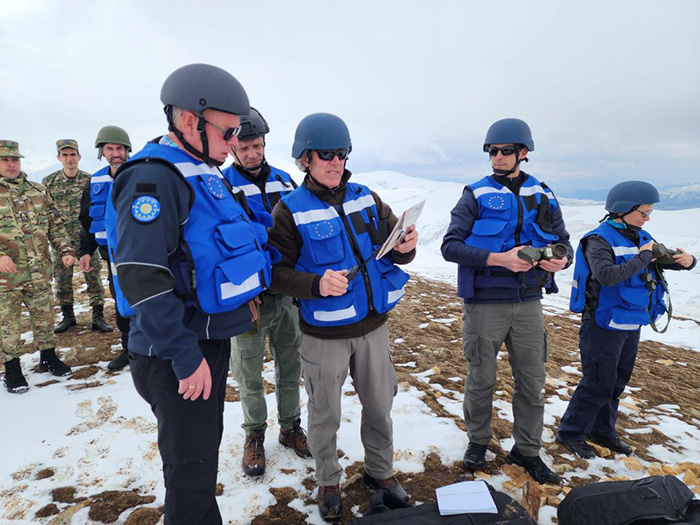
The European Union Mission in Armenia is an unarmed civilian mission. Its work includes observing conditions on the ground, reporting and supporting security and confidence in border communities. On May 10, Aliyev mocked the observers: “if we fired a single shot, they would immediately flee.”
Their purpose is not to fight Azerbaijan. It is to observe.
That distinction matters. When governments issue conflicting accounts of events along a border, independent reporting gives diplomats something more dependable than competing accusations.
Baku’s response to parliamentary scrutiny has followed a similar course. On May 1, Azerbaijan’s parliament announced that it was severing ties with the European Parliament following criticism concerning Armenian prisoners and the rights of Nagorno-Karabakh Armenians.
At the July 13, 2026 Shusha Global Media Forum, whose theme included “Restoring Truth and Rebuilding Trust,” Aliyev declared that Azerbaijan did not recognize decisions of the European Court of Human Rights. He also said his government had considered leaving the Council of Europe, but had put that move on hold following an appeal from its secretary general.
The contradiction was striking: a forum devoted to rebuilding trust became a platform for rejecting independent judicial scrutiny.
On October 8, Azerbaijan’s parliament rejected another European Parliament human-rights resolution, accused the institution of prejudice and interference, and portrayed its criticism as an obstacle to Armenian–Azerbaijani normalization.
This turns accountability into the alleged enemy of peace.
European institutions can be criticized. Their conclusions should be examined. But severing relations and attacking their legitimacy does not answer evidence about prisoners, repression or cultural destruction.
A government asking others to trust its intentions should expect questions. Peace cannot depend on everyone agreeing to stop asking them.
Peace Must Reach the Prisoners
For Armenian prisoners and their families, the gap between diplomatic celebration and daily life is especially stark.
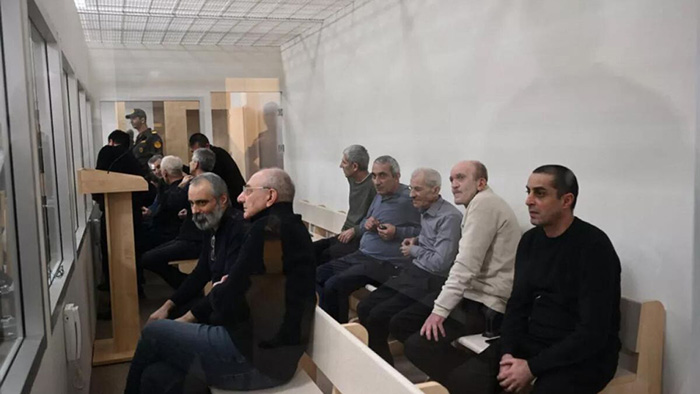
In February 2026, Ruben Vardanyan received a twenty-year sentence. Amnesty International condemned the proceedings against him and other ethnic Armenian defendants, citing military trials of civilians, effectively closed hearings and inadequately translated evidence.
These are fundamental questions about justice. A president’s comparison with Nuremberg cannot answer them.
In September, Human Rights Watch reported Vardanyan’s allegations that Armenian prisoners were being denied regular family contact, adequate exercise and medical tests. HRW explicitly said it had not independently verified the allegations; Azerbaijan’s human rights commissioner rejected them.
Independent access is precisely what can help establish the facts.
Azerbaijan closed the International Committee of the Red Cross’s delegation in September 2025. According to HRW, Geneva-based representatives visited prisoners that December, but visits have become less regular. The concern is therefore dependable access, not a claim that every visit has ceased.
Their release must remain a central diplomatic objective. Demanding medical care, family contact and independent visits protects people while efforts continue to bring them home; it does not endorse their imprisonment.
If Baku wants its justice system to be believed, it should permit the scrutiny that would allow others to assess it. Prisoners should not become trophies displayed in speeches about peace.
The Azerbaijanis Peace Will Need
The same system punishes Azerbaijanis who could help build a different relationship with Armenia.
Researcher and peace activist Bahruz Samadov remains imprisoned under a fifteen-year sentence imposed in June 2025. On September 25, 2026, Amnesty International renewed its demand for his immediate, unconditional release, describing the treason charges arising from his peaceful activism and contacts with Armenians as fabricated.
His case makes the contradiction unusually clear. The government negotiates with Armenia while a citizen who advocated dialogue with Armenians remains behind bars.
The repression has continued since Washington. On September 7, human-rights defender Anar Mammadli received a thirteen-year sentence. Amnesty described him as a prisoner of conscience and said the prosecution had failed to establish credible evidence of the alleged offenses. His conviction followed lengthy sentences against people associated with Toplum TV and other independent initiatives.
This matters beyond Azerbaijan’s domestic politics.
Durable peace needs journalists who can investigate official claims, scholars who can question inherited hostility and citizens who can speak across the border without fearing prosecution.
These Azerbaijanis also refute collective blame. They are not an extension of Aliyev’s government. Some have paid heavily for challenging it.
The pattern suggests that Aliyev wants the international benefits of peace without surrendering the domestic politics of enmity.
Armenia cannot make its security depend on Azerbaijan becoming democratic. But silencing the people most willing to question permanent enmity makes a peaceful neighborhood harder to build.
History Cannot Be Cleared Away
The treatment of Armenian heritage offers another test that can be checked independently.
Caucasus Heritage Watch’s October 2026 report documented the destruction of four sites after the Washington meeting: the Armenian Genocide Memorial, St. Jacob Church and Holy Mother of God Cathedral in Stepanakert, and the Old Armenian-Russian Cemetery in Shushi.
Its satellite evidence places the destruction of the three Stepanakert sites between October 12, 2025, and April 25, 2026, and the cemetery’s destruction in May 2026. These were losses during the peace process, not merely damage inherited from an earlier war.
Diplomatic tours offer no substitute for that kind of independent examination.
In September, presidential aide Hikmet Hajiyev showed visiting diplomats blank pages in manuscript reproductions at Gandzasar, presenting them in a way that questioned Armenian history. The Matenadaran, Armenia’s manuscript institute, explained that these were exhibition copies: selected openings had been reproduced for display, while other pages remained blank. It showed corresponding originals and received the EU’s regional representative in Yerevan.
The originals were available. A claim about history could be tested by examining them.
Aliyev has also addressed religious audiences in terms that widen hostility. On September 15, speaking to visiting Muslim religious leaders, he presented alleged Armenian mosque desecration as an insult to the entire Islamic world. In the same speech, he expressed confidence in lasting peace with Armenia.
Damage to Azerbaijani religious heritage deserves honest investigation. Turning allegations into a sweeping indictment of the Armenian state before a religious audience serves a different purpose: it encourages a wider audience to view Armenia with suspicion.
Reconciliation requires room for a former enemy to become a neighbor. It becomes harder when governments keep presenting that neighbor as an enduring civilizational threat.
Make Partnership Answer to Evidence
Washington and European capitals have reasons to engage Azerbaijan. Energy, transport and regional stability are legitimate interests. Those interests are better protected by reliable conduct than by assurances that cannot be independently tested.
They should make deeper cooperation depend on specific results: the release of Armenian prisoners, dependable humanitarian access while they remain held, independent heritage monitoring, an end to official territorial intimidation and freedom for peaceful advocates of dialogue.
They should support Armenia’s defense and sovereignty while pressing for practical measures that reduce the danger of another war.
There are already voices calling for this approach. An October 9 statement from Senator Adam Schiff’s office announced a bipartisan letter supported by more than one hundred members of Congress. It urged Secretary of State Marco Rubio to secure Armenian prisoners’ release, address Azerbaijan’s military presence inside Armenia and withhold military assistance if Baku continued jeopardizing negotiations. The letter specifically challenged the continued waiver of Section 907 restrictions.
Such demands should become part of sustained policy. Assistance decisions need evidence and enforceable conditions. Targeted sanctions against officials responsible for serious abuses or corruption should remain available, with clear grounds and clear requirements for their removal.
The aim is to make coercion costly and cooperation worthwhile.
Responsibility for Aliyev’s threats rests with Aliyev. Their continuation does not make Armenia’s pursuit of peace a mistake. It makes international restraint of Azerbaijan—and support for Armenia’s ability to negotiate and defend itself—more urgent.
The diaspora should support the Armenian government’s efforts to secure peace, strengthen defense and preserve the Republic’s freedom of action. Disagreements with Pashinyan must not obscure the source of the threats examined here or turn outside aggression into another accusation against the government confronting it.
That support can take practical forms: documented briefings for legislators, sustained advocacy for prisoners, support for independent researchers and journalists, and investment in Armenia’s capabilities.
Our advocacy should press Armenia’s partners to restrain Azerbaijan while helping Armenia build the capacity to negotiate, defend itself and choose its own future.
Aliyev asks the world to recognize the peace he says he has delivered.
The world should insist on being able to examine it.
Berge Jololian is an Armenian-American IT and cybersecurity professional based in Yerevan, Armenia, and Watertown, Massachusetts. His writing examines Armenian statehood and sovereignty, relations between the Republic and the Diaspora, regional security, and the strategic choices facing small states.
ROTTERDAM -- Armenian gymnast Hamlet Manukyan has been crowned world champion in the pommel horse…
Sunday attendance up 62% or 629. Young women 12% of total. Outreach visits reached 1,546.…
YEREVAN -- Armenia and the United States have discussed the construction of a new nuclear…
YEREVAN -- No incidents of physical violence against journalists were recorded in Armenia during the…
YEREVAN -- Armenia has been recognized as Europe's Leading Heritage Destination 2026 at the World…
YEREVAN -- The United States has donated approximately $1.4 million worth of vehicles and specialized…