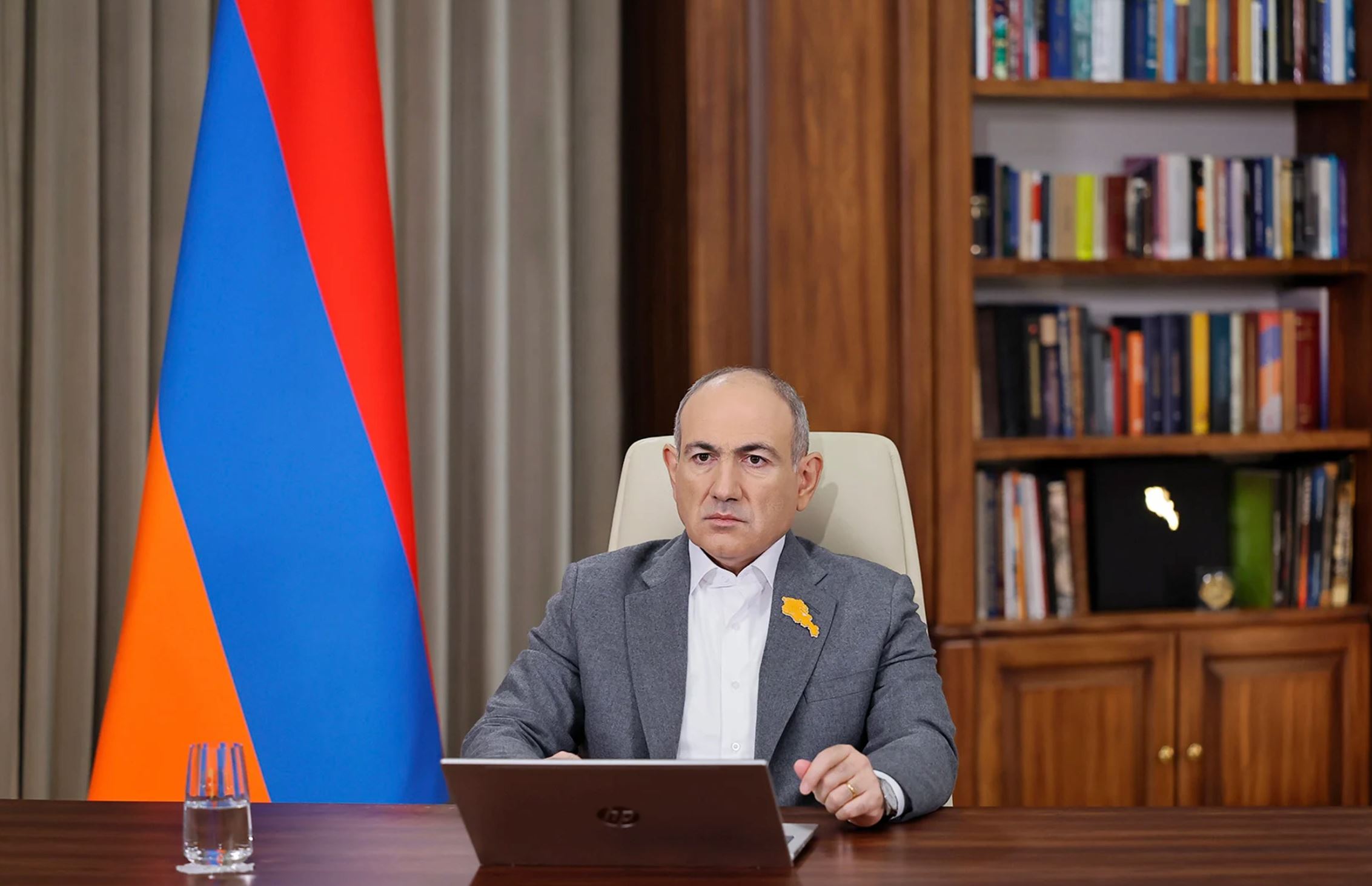
YEREVAN — Armenia’s draft new Constitution was published on November 23, with Prime Minister Nikol Pashinyan declaring that the proposed constitutional changes are intended to secure the country’s sovereignty, lasting peace, and statehood, rather than satisfy external demands.
“Never, under any circumstances, be tempted to think that we are doing this because of external pressure or for someone else’s sake,” Pashinyan said in a televised address to the nation following the publication of the draft Constitution.
The prime minister addressed the proposed departure from the principles of Armenia’s 1990 Declaration of Independence, arguing that the country must move beyond what he described as its conflict-oriented political framework.
According to Pashinyan, Article 8 of the proposed Constitution establishes the pursuit of peace as a central objective of Armenia’s foreign policy. He described the provision as a “historic declaration” marking a fundamental shift in the country’s political direction.
Pashinyan said the new Constitution would represent a departure from what he characterized as the conflict-driven logic of the August 23, 1990, Declaration of Independence.
“Our goal is to transform the Republic of Armenia from a country entrenched in trenches into a crossroads of peace,” he said, emphasizing the need for a military capable of independently defending Armenia’s internationally recognized borders and territorial integrity.
Pashinyan Proposes a Fourth Republic
The prime minister presented the constitutional initiative as the foundation for establishing a “Fourth Republic,” which he said would differ fundamentally from the current Third Republic.
According to Pashinyan, the Third Republic was shaped by conflict, while the defining characteristic of the proposed Fourth Republic should be the absence of conflict.
He argued that the Nagorno-Karabakh conflict and the prolonged negotiation process had brought Armenia dangerously close to losing its statehood.
Pashinyan also linked constitutional reform to the normalization of relations with Azerbaijan, pledging that Armenia would sign and ratify a peace agreement following the adoption of the new Constitution.
“I am putting my entire political, personal, and moral credibility on the line,” he declared, expressing confidence that constitutional reform would pave the way for institutionalized, lasting, and irreversible peace with Azerbaijan.
He maintained that Armenia now has an opportunity to achieve peace, independence, and statehood simultaneously, rather than being forced to choose between them.
Constitutional Reform and Judicial Independence
Pashinyan also criticized previous administrations, accusing them of misappropriating state resources and allowing oligarchic interests to influence the judiciary.
He argued that the existing constitutional framework protects what he described as a criminal-oligarchic justice system and that one of the objectives of the proposed Constitution is to free the judiciary from oligarchic influence.
“With the adoption of the new Constitution, the state must be returned to the people. With the adoption of the new Constitution, peace must be returned to the people,” he said.
The prime minister renewed his appeal to parliamentary opposition lawmakers to provide the six additional votes he said were necessary to submit the draft Constitution to a nationwide referendum.
“I propose that the opposition vote in favor of putting the draft Constitution to a referendum so that we can hold a constitutional referendum,” he stated.
Pashinyan reiterated his commitment to resign as prime minister if voters reject the proposed Constitution.
If the referendum succeeds, however, he pledged not to seek the premiership in the next parliamentary elections, whether regularly scheduled or early elections.
Until then, he said, his priority would be to institutionalize and finalize the peace process.
The prime minister also accused opposition forces of obstructing efforts to establish peace, expressing hope that opposition lawmakers would not prevent the constitutional referendum from taking place.
YEREVAN — Prime Minister Nikol Pashinyan and NVIDIA Vice President Rev Lebaredian discussed Armenia’s growing…
By KRIKOR KHODANIAN The most pressing issue currently on Armenia’s political agenda is the adoption…
YEREVAN — DigiTec 2026, Armenia’s leading technology conference, has opened in Yerevan, bringing together industry…
WASHINGTON, D.C. — The Armenian Council of America (ACA) welcomes the renewed congressional attention to…
YEREVAN — Armenia’s Ministry of Justice will publish the draft of a new Constitution on…
YEREVAN — Firebird is expanding its artificial intelligence computing infrastructure in Armenia through its continued…