Government House on Republic Square, Yerevan. The existence of a sovereign Armenian state transforms the Diaspora’s responsibility: from preserving Armenian identity alone to helping build the power of the Republic. Photo: Vyacheslav Argenberg / Wikimedia Commons, CC BY 4.0.
By BERGE JOLOLIAN
One of the great Armenian success stories of the past century happened far from Armenia.
Across the world, Armenians arrived in new countries and built new lives. They built businesses and institutions, became leaders in their professions, enriched the cultures around them and became part of the countries they called home.
And through it all, they remained Armenian.
A French Armenian could be fully French and fully Armenian. The same became true in America, Lebanon and across the Diaspora. Armenians adapted without disappearing.
That is an extraordinary Armenian strength.
For much of that history, however, there was no independent Armenian state.
Today there is.
And that opens a new possibility.
The strength Armenians built across the world—knowledge, experience, networks, capital and influence—can now also strengthen Armenia itself.
How do we turn Diaspora strength into Armenian strength?
Armenians Have Done This Before
The ability to adapt without disappearing was not invented by the modern Diaspora.
Armenians had done it centuries earlier—with a state.
After the fall of the Bagratid Kingdom of Ani in the eleventh century, Armenian political life did not simply vanish. Far to the west, in Cilicia along the eastern Mediterranean, Armenians built again. Mountain strongholds became principalities, and the principalities became a kingdom.
In 1198, Prince Levon was crowned King of Armenia at Tarsus.
The crown was the result of ambitious diplomacy. Levon had appealed to Pope Celestine III and Holy Roman Emperor Henry VI—whom the eminent historian Sirarpie Der Nersessian called “the two most powerful rulers of the time.”
At Tarsus, Catholicos Gregory VI Abirad anointed Levon, while Archbishop Conrad of Mainz presented the royal insignia. Armenian chroniclers also record that Byzantine Emperor Alexios III sent a crown.
Armenian kingship had returned—with international recognition. Der Nersessian wrote that Armenians saw their ancient kingdom “restored and renewed” in Levon.
Cilicia did more than survive.
It opened itself to the world.
Its rulers cultivated relations with the papacy, the Holy Roman Empire, Byzantium and the maritime cities of Europe. They also dealt with Arab rulers and other Muslim powers in Syria, Egypt and Anatolia.
They encouraged commerce, granted privileges to foreign merchants and turned their ports into gateways between East and West. Genoese and Venetian traders came to Cilicia; goods arriving from Asia moved through its markets toward Europe.
The kingdom learned from the people around it without surrendering what it was.
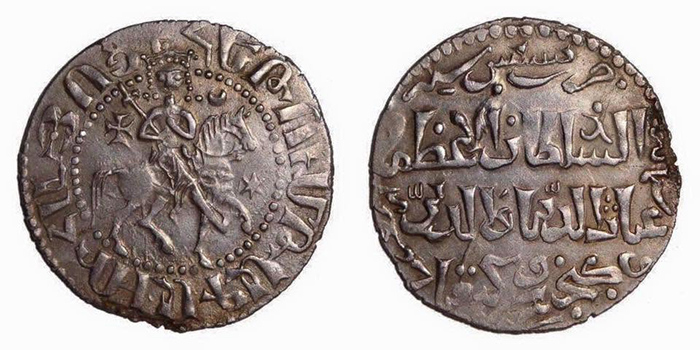
Even its money tells the story. Under King Hethum I, Cilicia struck remarkable bilingual silver coins: the Armenian king and an Armenian inscription on one side, and an Arabic inscription naming the Seljuk sultan on the other.
Two languages. Two political worlds. One Armenian kingdom.
That was not confusion about identity. It was an Armenian state learning how to operate in the world around it.
Historian Claude Mutafian gave this achievement an apt title: The Brilliant Diplomacy of Cilician Armenia.
The brilliance was not that Cilician rulers possessed overwhelming power. They did not. It was that they understood their limitations without allowing those limitations to dictate their fate.
They created options.
They traded in several directions, cultivated different powers and adjusted when the balance around them changed.
Then the Mongols swept across Eurasia. King Hethum understood that this was a power Cilicia could neither defeat nor afford to ignore.
Rather than wait for the Mongols to determine Armenia’s fate, Hethum went to them.
In 1254, the Armenian king traveled to Mongolia and met Great Khan Möngke. He confirmed Cilicia’s alliance with the power transforming the region.
It was bold—and successful. Cilicia gained a formidable ally in an increasingly dangerous neighborhood.
Hethum could not stop the world from changing.
He could make sure Armenia changed with it.
That may be the most important legacy of Cilician diplomacy: a relatively small Armenian kingdom created room for itself among much stronger powers.
It did not confuse independence with isolation.
It adapted without ceasing to be Armenian.
Memory and Strategy
That distinction matters because Armenians carry an unusual amount of history.
We carry the Armenian Genocide and the destruction of Western Armenian civilization. More recently, we carry the trauma of the 2020 war, the loss of Artsakh, the displacement of its Armenian population and the deaths of thousands of Armenian soldiers.
These are not abstractions. They remain wounds within living families and communities. Nothing about an Armenia-centered strategy requires forgetting them.
But memory and strategy perform different functions.
Memory tells us who we are and what happened to us. Strategy asks what must be done now so that Armenia survives and prospers.
The Republic cannot conduct foreign policy toward the Ottoman Empire of 1915, the Soviet Union of 1975 or even the South Caucasus of 2020. It must deal with Russia, Turkey, Azerbaijan, Iran, Europe and the United States as they exist today.
Memory should produce vigilance. It should not produce strategic paralysis.
Creating Options
Nowhere is that distinction more important than in Armenia’s relationship with Russia.
For decades, Armenia’s security architecture rested heavily on Moscow. That model failed when Armenia needed it most. Russia did not prevent Armenia’s defeat in 2020. The Russian-led Collective Security Treaty Organization did not provide the expected protection when Azerbaijani forces entered internationally recognized Armenian territory. Russian peacekeepers did not prevent the blockade, military offensive and eventual depopulation of Artsakh.
None of this makes Russia irrelevant. It remains a major regional power and an important economic partner. Armenia gains nothing from manufacturing unnecessary hostility with Moscow.
But neither should Armenia reconstruct its security around the same level of dependence that proved unreliable.
Nostalgia can be comforting. Unfortunately, it is not a security guarantee.
The useful question is not whether Armenia should be “pro-Russian” or “pro-Western.” It is how Armenia can avoid becoming excessively dependent on anyone.
That is why growing defense relationships with France and India, along with deeper engagement with Europe and the United States, matter. The objective is not to exchange Moscow for Washington, Paris or Brussels. It is to create alternatives.
Diversification is not anti-Russian. It is insurance against dependency.
The same realism is necessary in dealing with Turkey.
For much of the Diaspora, Turkey remains inseparable from the Armenian Genocide. That is understandable. But the Republic must also deal with modern Turkey: a country of more than 80 million people, a NATO member, a major regional military power and an increasingly sophisticated producer of defense technology.
Armenians do not have to admire that reality.
Armenian strategy does have to understand it.
Former Turkish parliamentarian Garo Paylan—an Armenian who publicly challenged Genocide denial in Turkey—has also advocated normalization and the opening of the Armenia–Turkey border.
An open western border would not erase the Genocide or eliminate Armenia’s security concerns. But it could expand Armenia’s commercial and transportation options and reduce its isolation.
The Diaspora has every right to raise concerns about Turkish policies. But political capital is finite. Before committing Armenian influence to a broader dispute, it is worth asking whether doing so advances a concrete Armenian interest.
Does it improve Armenia’s security or leverage? Or does it expend Armenian political capital without materially changing American policy?
Understanding is not appeasement. Engagement is not surrender. Normalization does not require amnesia.
Azerbaijan requires a different posture.
The destruction of Armenian political life in Artsakh, the displacement of its Armenian population, the continued detention of Armenian prisoners and repeated military pressure make clear that peace must be pursued seriously—but with realism and the capacity to defend it.
The initialing of a peace agreement in Washington in August 2025 was an important step. It deserves support. But peace will become durable only through implementation: respect for Armenia’s sovereignty, renunciation of force, release of Armenian detainees and a credible capacity to deter renewed coercion.
Here, Diaspora advocacy can directly serve Armenia: supporting its defense capabilities, pressing for the release of detainees, defending Armenian sovereignty and increasing the political cost of renewed coercion.
Armenian-American organizations have kept Armenian security, human rights and U.S.–Armenia relations before policymakers. Their advocacy also contributed to recognition of the Armenian Genocide.
Those achievements matter.
But advocacy should ultimately be measured by what it accomplishes for Armenia.
What does Armenia gain?
Where engagement creates economic, diplomatic or security opportunities, Armenia should explore them. Where pressure can deter aggression or strengthen Armenia’s position, the Diaspora should apply it.
Good strategy searches for openings.
The State Beyond Politics
Prime Minister Nikol Pashinyan and his government are not above criticism.
His communication has sometimes been unnecessarily abrasive on subjects carrying enormous historical and emotional weight. Greater care around Artsakh, historical memory, national symbols and the Armenian Apostolic Church would often have served the country better.
But criticism of a government should not become rejection of everything Armenia undertakes while that government is in office.
The loss of Artsakh was a national catastrophe, and thousands of Armenian soldiers died in the 2020 war. Those losses cannot be minimized. Nevertheless, Armenia must rebuild its military, strengthen its economy, protect its borders and reduce the vulnerabilities exposed by war.
Recognizing progress is not absolution.
One can oppose Pashinyan while welcoming stronger defense relationships with France and India, closer ties with Europe and the United States, or policies that give Armenia greater freedom of action.
A useful policy does not become harmful simply because a politician one dislikes pursued it.
Governments should be judged by Armenia’s citizens. But changing a government does not change Armenia’s geography, Turkey’s power, Azerbaijan’s capabilities or the shortcomings of its former security system.
Replacing a government cannot substitute for a national strategy.
The same principle applies to national institutions: the Armenian Apostolic Church’s spiritual independence and the state’s political authority should both be respected.
The Diaspora should defend neither Pashinyan nor his opponents.
It should defend Armenia’s capacity to decide its own future.
Strategic diversification should not belong to Pashinyan.
It should belong to Armenia.
Governments are temporary. The Republic is larger than any one of them.
Building Armenian Power
This brings us to the opportunity.
The Diaspora’s greatest contribution may lie not in choosing Armenia’s political direction from abroad, but in increasing Armenia’s capacity to choose for itself.
Diaspora Armenians possess resources Armenia needs: capital, expertise, technology, educational networks, political relationships and access to markets.
Those resources are potential Armenian power.
Security is not built only with weapons. Transport links, energy networks, digital infrastructure and productive investment create jobs, transfer knowledge and give other countries a stake in Armenia’s stability.
Interdependence is not a substitute for deterrence. But a country connected to more markets, institutions and centers of power has more options—and is harder to isolate.
Political advocacy matters, especially when it protects Armenia from aggression or creates useful leverage. But Armenian influence abroad can accomplish much more.
It can connect Armenian universities with leading institutions, Armenian technology companies with global capital and Diaspora expertise with Armenia’s needs. Diaspora businesses can see Armenia not merely as a charitable cause, but as a place to build, employ and invest.
A congressional resolution can be useful.
But symbolic support should not be mistaken for strategic capability.
The most consequential Armenian lobby of the twenty-first century may not be the one that becomes better at punishing Armenia’s enemies.
It may be the one that becomes exceptionally good at building Armenian power.
The Diaspora does not need to govern Armenia in order to transform it.
It can bring expertise rather than instructions, capital rather than slogans, networks rather than dependency, and opportunity rather than despair.
This is not abandoning the Armenian Cause.
It is adapting the Armenian Cause to the existence of an Armenian state.
For generations, preserving Armenian memory was an act of national survival. That responsibility remains. The Armenian Genocide and Artsakh must be remembered. Armenian culture and identity must be preserved.
But Armenia now needs something more from us.
It needs a Diaspora capable not only of remembering what Armenians lost, but of helping build what Armenia can become.
More than eight centuries ago, Cilician Armenia survived by understanding the world as it was, preserving identity without turning it into isolation and building relationships wherever Armenian interests required them.
Cilician Armenians adapted without ceasing to be Armenian.
Modern Armenia must be free to do the same.
And the Diaspora can help give it the strength to do so.
Whenever we lobby, invest, organize, criticize, educate or mobilize, the test with which we began remains useful:
Does this strengthen the Republic of Armenia?
Does it improve Armenia’s security? Reduce dangerous dependencies? Bring knowledge, capital, technology or useful relationships?
The Diaspora does not need to choose Armenia’s government. Armenians in Armenia can do that themselves.
Its greater contribution is to help ensure that whichever government they choose inherits a stronger country—with better defenses, stronger institutions, more partners and greater economic capacity.
The objective is not to keep any particular government in control of Armenia.
It is to keep Armenia in control of Armenia.
Preserving Armenian memory remains essential.
Building Armenian power must now become equally central.
The Republic must endure—and grow stronger.
Berge Jololian is an Armenian-American IT and cybersecurity specialist based in Yerevan, Armenia. He writes on Armenian statehood, sovereignty, regional security, and the geopolitics of the South Caucasus, with a particular interest in the strategic challenges facing small states in a changing international order.
Memoir Features Contributions from Pulitzer Prize-Winning Author Peter Balakian and System of a Down’s Serj…
YEREVAN -- The Armenian government has adopted a decision recognizing all shares of Electric Networks…
Authors Hrayr Karagueuzian and Dr. Levon V. Demirdjian Explore How Understanding Health Risks Can Help…
GYUMRI -- The Hayastan All-Armenian Fund and the TUMO Center for Creative Technologies have signed…
CAIRO -- Armenian shooter Elmira Karapetyan has won the gold medal in the women's 10-meter…
ALBANIA -- Armenian weightlifters have delivered impressive performances at the European Junior and U23 Weightlifting…