By BEDROSS DER MATOSSIAN
It was in the early 1990s that my interest in the Armenian Genocide, late Ottoman history, and the study of mass violence first began to take shape. At that time, without access to the internet or a personal computer, the university library became my gateway to the world of genocide scholarship. As an undergraduate at the Hebrew University, I spent countless hours sifting through books on the Armenian Genocide. It soon became clear that many of the most influential works in the field were the product of the Zoryan Institute and, in particular, the scholarship of its Research Director, Prof. Vahakn N. Dadrian. Often called the architect of Armenian Genocide studies in Western academia, Dadrian’s groundbreaking work was possible only through the steadfast support, resources, and vision of the Zoryan Institute.
For those unfamiliar with it, the Zoryan Institute of Canada is a registered non-profit organization—and a uniquely important one. It is dedicated to advancing rigorous scholarship and fostering public awareness around genocide, human rights, and diaspora studies. Crucially, the Institute operates independently, free from political, governmental, or religious influence. This independence safeguards the integrity and credibility of its mission. In an era when denial, distortion, and the erosion of historical truth threaten our collective moral compass, the Zoryan Institute stands as a vital bulwark for human dignity and social justice.
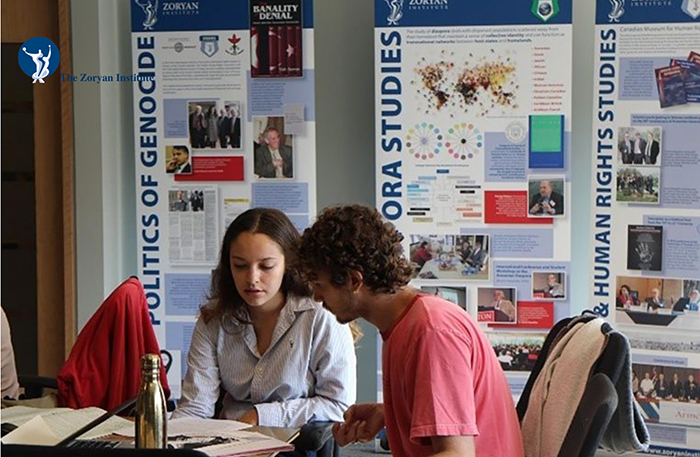
Zoryan conducts comparative and multidisciplinary research on genocides and gross human rights violations worldwide—from the Holocaust and the Armenian Genocide to the Cambodian and Rwandan genocides. Its work has shaped the very foundations of genocide and human rights scholarship, influencing educators, policymakers, and civil society. But Zoryan’s impact extends even further. As home to the International Institute of Diaspora Studies (IIDS), the Institute is also a leading center for understanding how dispersed communities preserve identity, form transnational networks, and shape cultural and political landscapes across borders.
One of its most visionary initiatives is the Genocide and Human Rights University Program (GHRUP), a highly respected graduate-level summer course that has trained hundreds of emerging scholars and educators from around the world. Many of today’s leading voices in genocide studies trace their academic origins to this transformative program. Zoryan has also developed high-school genocide education initiatives in partnership with the Ontario Ministry of Education, equipping young people with the tools to understand equity, tolerance, and the consequences of dehumanization. These programs—taught in schools across Canada and beyond—help cultivate informed, empathetic global citizens.
Zoryan is also a guardian of memory. It maintains one of the largest collections of Armenian Genocide survivor testimonies and continues to expand its oral history archives through projects such as the 44-Day Artsakh War Oral History Project. Past efforts include documenting the experiences of Syrian-Armenian refugees rebuilding their lives in Canada—records that will serve generations of scholars, educators, and community members.
Through its publications, the Institute has achieved global reach. Its two peer-reviewed academic journals published with the University of Toronto Press—Genocide Studies International and Diaspora: A Journal of Transnational Studies—are regarded as leading platforms in their fields. Combined with its books, podcasts, webinars, and international collaborations, Zoryan continues to shape global conversations on human rights and shared human experience.
Across its decades of work, the Zoryan Institute’s impact can be seen in three key areas:
Educational empowerment: Equipping students, teachers, and communities with the tools to recognize injustice and advocate for human rights.
Scholarly influence: Training generations of researchers, professors, and thought leaders who now serve in institutions across the world.
Memory and prevention: Preserving testimonies and fostering dialogue to help prevent future atrocities.
Yet, despite its extraordinary contributions, the Zoryan Institute faces profound financial challenges. Unlike many academic institutions, Zoryan has no endowment and receives no institutional funding. It relies entirely on donors, partners, and supporters. At a time when universities are cutting programs and similar institutes in Canada have closed due to funding shortages, Zoryan’s work is more vulnerable—and more essential—than ever.
As the leading institution in North America dedicated to genocide studies, diaspora research, and human rights education, Zoryan’s future must be secured. Now is the moment for the Institute to establish its own independent endowment—one that will safeguard its mission, sustain its programs, and empower the next generation of scholars, educators, and human rights defenders.
Supporting the Zoryan Institute is not merely an act of philanthropy. It is an investment in truth, justice, and the preservation of collective memory. It is a commitment to ensuring that denial and distortion never eclipse historical reality. And, above all, it is a pledge to uphold human dignity in a world that needs it now more than ever.
Establishing an endowment may be a formidable undertaking, but it is well within reach when we truly appreciate the extraordinary importance of the Zoryan Institute’s mission. For decades, Zoryan has been cultivating future scholars—individuals who are not only contributing to today’s academic and policy worlds, but who will also become the moral and intellectual leaders of tomorrow. Their work will help shape how humanity understands justice, identity, and the dignity of all peoples.
By launching a global campaign, we ignite a movement that will safeguard and strengthen this mission for generations to come. An endowment is more than financial support—it is a powerful statement of belief in the transformative impact of knowledge, truth, and education. Its ripple effect will resonate across disciplines, empowering groundbreaking research in Comparative Genocide Studies, Diaspora Studies, and Human Rights Studies. Through this support, we nurture the ideas, discoveries, and conversations that push humanity toward greater understanding and compassion.
Such an endowment will not only sustain Zoryan’s legacy—it will elevate it. It will create stronger educational opportunities, cultivate more deeply trained scholars, and inspire greater public awareness. And in doing so, it will help build a brighter, more just, and more humane world—one where the lessons of the past guide the conscience of the future.
Bedross Der Matossian is a Guggenheim Fellow and Professor of Middle East History at the University of Nebraska, Lincoln. He is the author, editor, and co-editor of nine books.
Two numbers describe the challenge facing Armenian Christianity in America. One is low. The other…
STRASBOURG -- The European Court of Human Rights (ECHR) on September 24 rejected a request…
SYUNIK -- Alongside the Armenian-American TRIPP project, the European Union is also making major investments…
NEW YORK -- Prime Minister Nikol Pashinyan addressed the return of Armenian detainees held in…
YEREVAN -- Armenia’s national football team opened its 2026/27 UEFA Nations League campaign with a…
YEREVAN -- A formal ceremony honoring Dr. Yeghig Jerejian was held during the 23rd Congress…