This article will build on previous discussions of the Millet system (see Part III) to explore the expansion of cultural activities of the Armenian community during the Ottoman Empire.
The Armenian cultural renaissance of the eighteenth and nineteenth centuries within the Ottoman Empire, otherwise known as “Zartonk” in the Western Armenian tradition, illustrates how a semi-autonomous religious community could cultivate a rich intellectual and cultural life while remaining embedded within an imperial system, operating under the millet framework which denied personal rights. Armenians did not possess political sovereignty; however, the relative group autonomy granted to their millet created the institutional space necessary to consolidate education, religion, and cultural production around communal structures. This development is best understood as the formation of a public sphere within an imperial order, balancing strict central authority with local self-governance within respective millets.
At the center of the millet system was Istanbul, the imperial capital. The city simultaneously functioned as the administrative heart of the Ottoman state and the cultural capital of the Armenian millet. The presence of the Patriarchate, wealthy Armenian elites, and access to imperial networks allowed for the concentration of economic resources, intellectual talent, and Armenian institutional authority in Istanbul. This convergence made it possible for Armenians to develop a vibrant cultural life, even within the constraints imposed by Ottoman rule, so long as the broader balance between imperial stability and communal autonomy was maintained under the Sultan’s absolute authority.
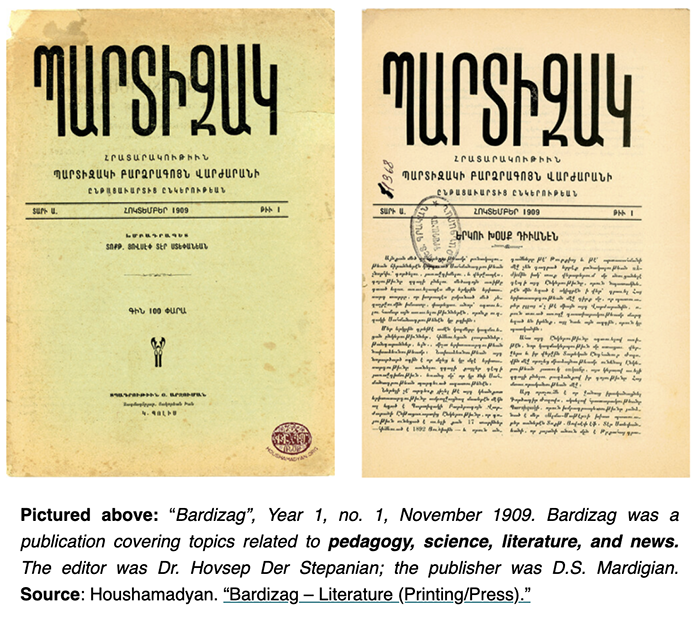
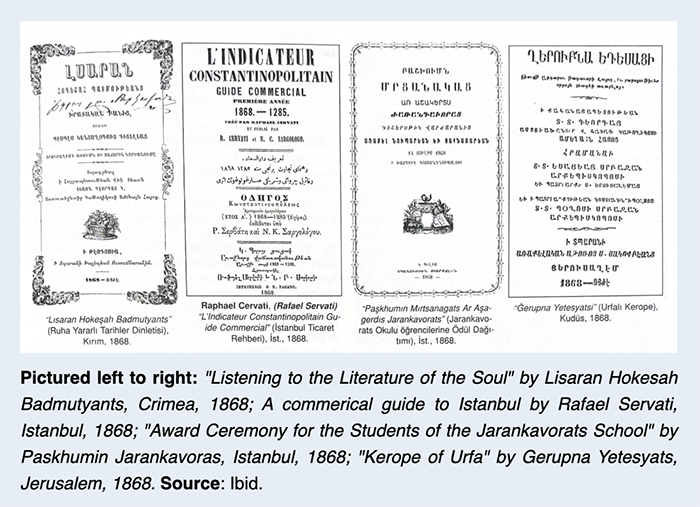
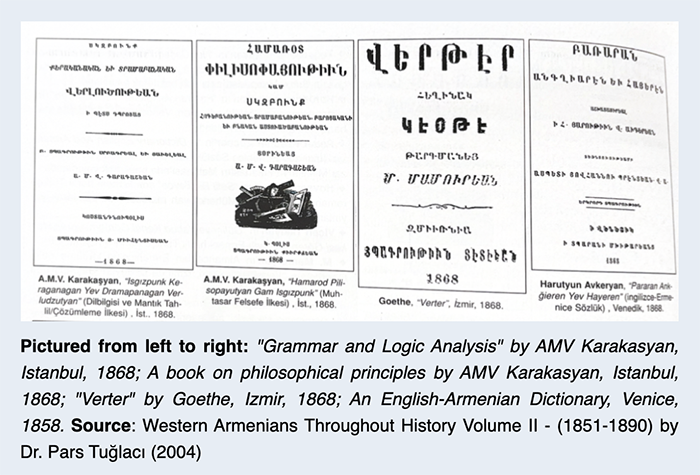
The expansion of the Armenian printing press played a foundational role in this renaissance. From the eighteenth century onward, presses in Istanbul produced religious texts alongside grammars, histories, and eventually secular works. This print culture contributed to the standardization of the Armenian language and enabled the circulation of ideas across dispersed communities. In modern terms, it created a shared communicative framework that strengthened collective identity and facilitated intellectual exchange.
Educational and journalistic institutions further reinforced this cultural consolidation. Schools, often rooted in church structures but increasingly influenced by lay participation, expanded their curricula to include modern subjects. Newspapers introduced a flow of information and opinion, fostering a sense of public discourse and communal awareness that extended beyond local boundaries.
Simultaneously, Armenian literature evolved beyond its traditional liturgical focus. Writers began to explore new genres, including journalism, essays, and early forms of the novel, engaging with questions of reform, education, and identity. These developments reflected broader intellectual currents, yet were shaped by the specific realities of Armenian life within the Ottoman system.
Intellectual societies complemented these developments by bringing together clergy, merchants, and scholars to promote learning and debate. While the Patriarchate remained central, authority gradually became more diffuse, reflecting a dynamic interaction between religious leadership and emerging secular voices.
In sum, the Armenian experience demonstrates that, within the Ottoman millet system, a community could generate many features of modern cultural life including education, media, and intellectual exchange, so long as it operated within the limits of imperial oversight and maintained equilibrium.
The Zoryan Institute invites you to share this release with five friends for Genocide Awareness Month to help promote understanding and reflection.
The Zoryan Institute
YEREVAN -- American technology giant NVIDIA has announced plans to expand its operations in Armenia,…
YEREVAN -- Armenia's State Revenue Committee (SRC) has published data on taxes and other payments…
YEREVAN -- Armenian Prime Minister Nikol Pashinyan met in Yerevan with Gert Jan Koopman, Director-General…
YEREVAN -- Armenia's ruling Civil Contract Party secured victories in most of the country's local…
PARAMUS, NJ – The Armenian Missionary Association of America (AMAA) held its 107th Annual Meeting…
YEREVAN -- On September 29, 2026, Katia Kermoyan-Khodanian, who had arrived in Armenia from the…