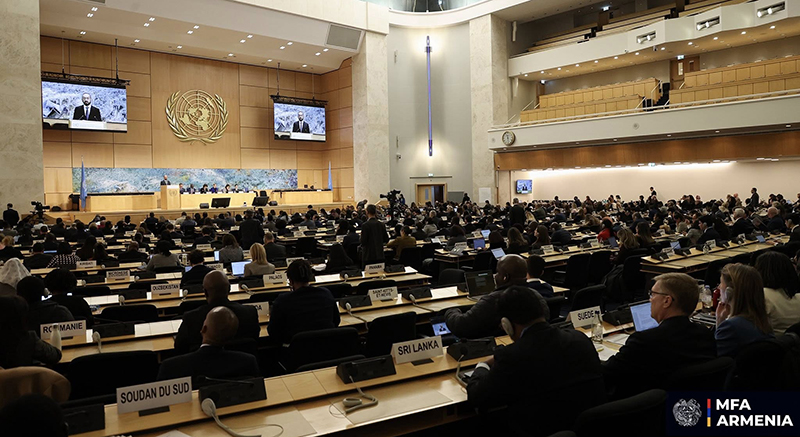
GENEVA — Reconciliation is a difficult undertaking, particularly considering the fate of 19 Armenian detainees still being held in Baku, the unresolved cases of missing persons and enforced disappearances, as well as distorted historical narratives, Armenia’s Foreign Minister stated at the UN Human Rights Council in Geneva.
“Nevertheless, Armenia remains firmly committed to continuing along this path, understanding that the further institutionalization of peace will foster a more favorable environment for addressing the consequences of the conflict,” said Ararat Mirzoyan.
According to the Foreign Minister, last year’s peace summit held in Washington “not only established peace between the two countries but also paved the way for trade, connectivity, and people-to-people contacts.”
“In order to move beyond agreements between governments, we are also sowing the seeds of genuine dialogue and trust between our societies, including among affected populations. Although the painful humanitarian consequences of the conflict remain unresolved, and the wounds of both the distant and recent past persist, we have chosen the difficult path of reconciliation,” Minister Mirzoyan noted.
Turning to domestic matters, Mirzoyan emphasized: “Over the years, significant reforms, a higher level of policy based on the rule of law and human rights, as well as transparent and accountable institutions, have produced tangible development results, reflected in internationally recognized indices.”
In Freedom House’s Freedom in the World 2025 report, Armenia received a score of 54 out of 100, recording high marks in political rights and civil liberties.
“A significant achievement is also the fact that in 2025 Armenia ranked 34th in the Reporters Without Borders World Press Freedom Index 2025, demonstrating notable progress compared to the previous year’s 43rd position.
“In line with Armenia’s commitment to the systematic and effective implementation of its international human rights obligations, last year the digital tool of the national mechanism for strengthening international human rights reporting was launched — Armenia’s oversight digital platform (AI-NEMRA). It is a centralized system that consolidates recommendations issued by international and regional human rights mechanisms,” the Minister stated.
YEREVAN — Armenian Prime Minister Nikol Pashinyan has proposed a political scenario under which he…
YEREVAN — American engineering and consulting firm AECOM has presented the preliminary findings of its…
YEREVAN — Armenia has been invited to participate as a guest country in the upcoming…
YEREVAN — A 10 percent increase in natural gas prices in Armenia could raise inflation…
YEREVAN — Armenian Security Council Secretary Alen Simonyan announced on November 19 that he plans…
STANFORD, CA — Armenian Minister of High-Tech Industry and Artificial Intelligence David Tadevosyan met with…