By Eng. HAMBERSOM AGHBASHIAN
The Armenian Cultural Heritage in Turkey Today
The eastern part of Turkey is part of Western Armenia. During and after the Armenian genocide, the Armenian cultural heritage was targeted for destruction by the Turkish government. Of the thousand churches and monasteries in the Ottoman Empire in 1914, today only less than forty are still standing in some form; most of these are in danger of collapse. Those that continue to function are mainly in Istanbul.
Armenian Churches
Most of the Armenian churches in Turkey are either in ruins or are being used for other purposes. Armenian churches still in active use are mainly located in Istanbul; they belong to various denominations, primarily the Armenian Apostolic, Catholic, and Evangelical Protestant.
Following the Armenian Genocide starting in 1915, most Armenian churches and monasteries were either deliberately destroyed or abandoned. Of the thousands that existed before 1915, only a fraction remains today, many of them in ruins.
In some instances, the Turkish army used explosives to destroy churches and monasteries during training exercises, with the rubble and stone then becoming available for reuse.. Armenian churches were typically built with finely cut stone, making it a desirable material for constructing homes and other village buildings. Researchers have observed that this practice is common throughout Western Armenia. This repurposing of materials is part of a broader pattern of erasing Armenian history and physical presence in the region. This has included converting some churches into mosques, stables, or warehouses.
Armenian historical Churches demolished in Turkey (Western Armenia)
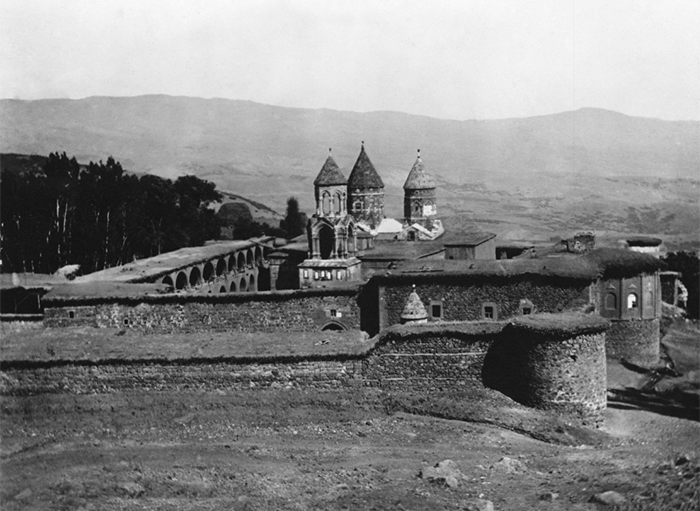
Surb Garabed Monastery:
The Saint Garabed Monastery was an Armenian monastic complex located in the Taron Province of Western Armenia, near the town of Mush, which is now in the Kurdish village of Chengeli. Founded in the 4th century by Saint Krikor the Illuminator.
It was one of the oldest monasteries in Armenia and served as one of the three most important sites for Armenian Christian pilgrimage. After the Armenian genocide, the monastery was reduced to its foundations. Today, carved stones from its ruins can be found incorporated into nearby homes.
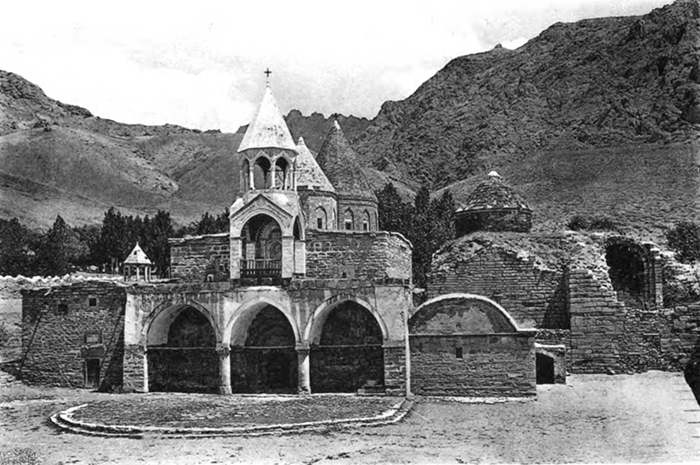
Varagavank Monastery:
An Armenian monastery complex, located in the historical province of Vaspurakan, was built in the 7th century. It is situated southeast of the city of Van, on the western slope of Mount Varaga. This complex served as the residence of the Archbishop of Van but was destroyed during the Armenian Genocide. The stones from this historic monastery were intentionally taken for use in the construction of a mosque and local houses.
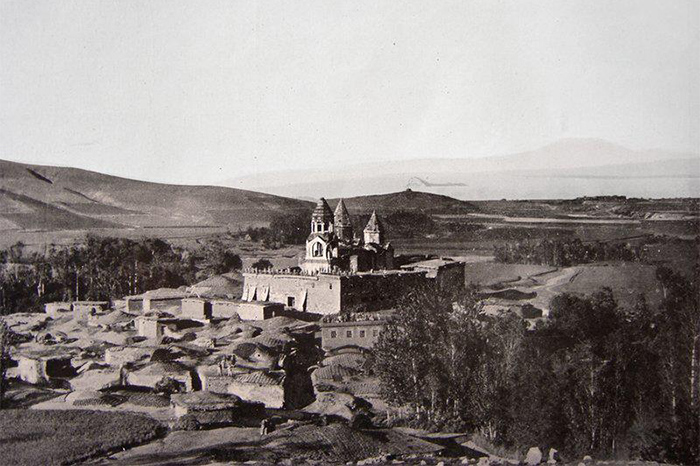
Narekavank “Monastery of Narek”:
It was a tenth-century Armenian monastery in the historic province of Vaspurakan, near the southern shores of Lake Van. The monastery was one of the most prominent in medieval Armenia and had a major school.
Krikor of Narek (Krikor Narekatsi) who was an Armenian mystical and lyrical poet, monk, and theologian the author of (Book of Lamentations -Narek) was based throughout his life at the monastery of Narek. The monastery was abandoned in 1915 during the Armenian genocide, and reportedly demolished around 1951. A mosque now stands on its location.
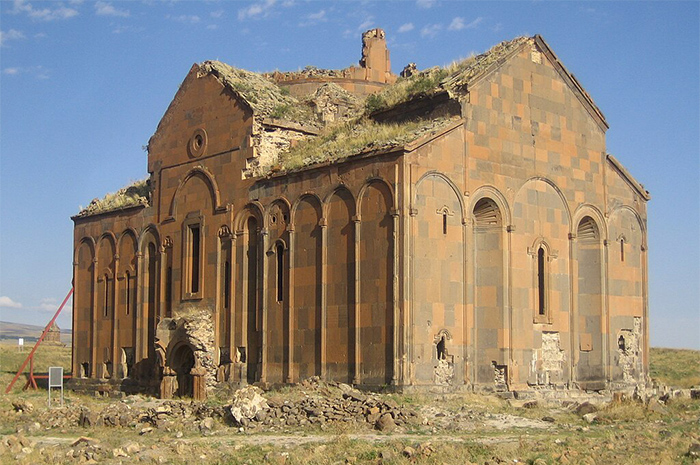
The Cathedral of Ani:
Ani, the capital of the medieval Armenian kingdom of the Bagradonian dynasty, features a blend of churches and military structures, all of which are in ruins.
This site has been designated as a UNESCO World Heritage site and holds significant cultural importance for Armenia. Currently, there is an ongoing preservation project initiated by Turkey. In July 2025, a report from Turkey’s state-run Anadolu Agency announced that the historic Armenian Cathedral of Ani would be reopened as a mosque.
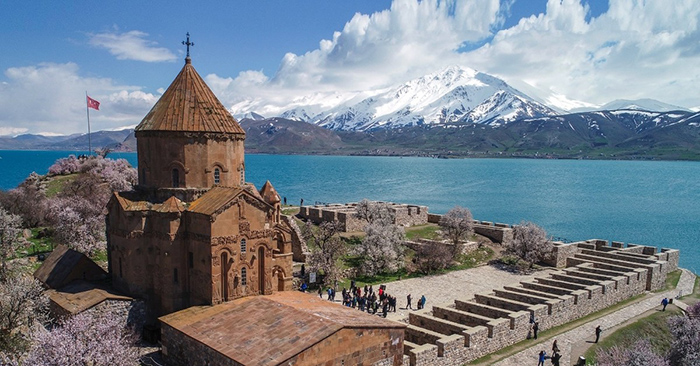
The Cathedral of the Holy Cross on Akhtamar:
The Cathedral of the Holy Cross, situated on Akhtamar Island in Lake Van, Western Armenia, is a medieval Armenian Apostolic cathedral. Originally built as a palatine church for the kings of Vaspurakan, it later became the seat of the Catholicosate of Aghtamar.
The Cathedral of the Holy Cross, situated on Akhtamar Island in Lake Van, Western Armenia, is a medieval Armenian Apostolic cathedral. Originally built as a palatine church for the kings of Vaspurakan, it later became the seat of the Catholicosate of Aghtamar. After the Genocide of 1915, the church fell into disuse for many decades. In 2005, it underwent extensive restoration and was subsequently opened as a museum by the Turkish government. Today, it is a popular tourist destination and hosts an annual Mass celebrated by the Armenian community.
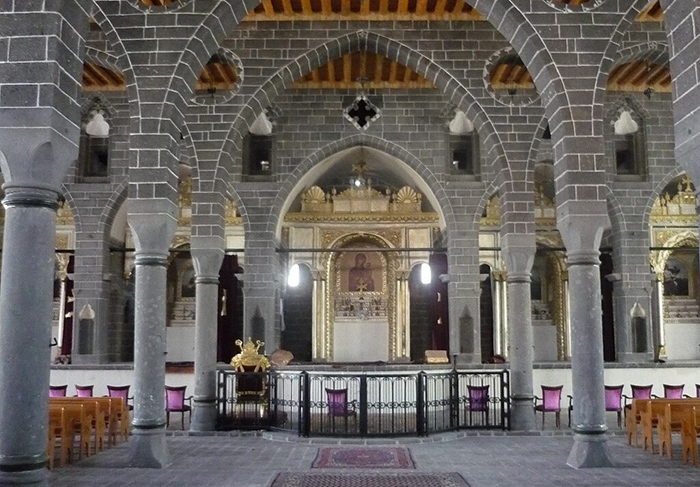
St. Giragos Armenian Apostolic Church in Diyarbakır:
It is the largest Armenian church in the Middle East, recently restored and reopened for services after being in disrepair for decades. The church, dating back to the 16th century, has been a symbol of the once large Armenian community in the city.
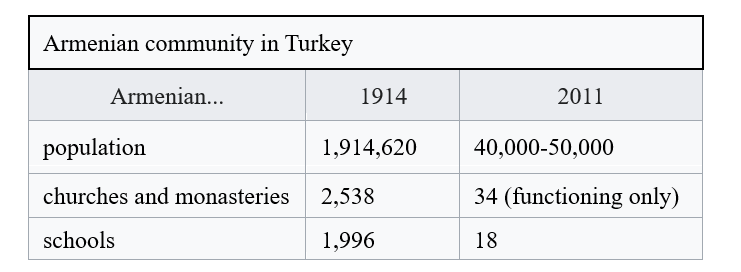
Currently, most of the 2,538 Armenian churches and monasteries have either been demolished or repurposed as stables, warehouses, or for other uses, with some even converted into mosques. Only 34 churches are still functioning, and most of them are located in Istanbul.
Armenian Schools
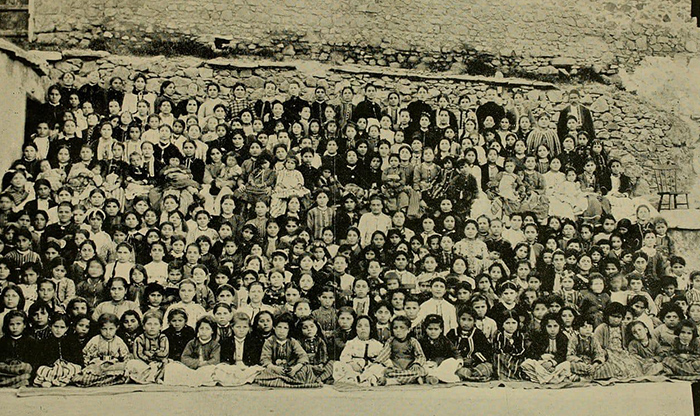
During the Ottoman Empire, Armenian schools were not permitted until the late 18th century. Nevertheless, Armenians established many schools unofficially. In 1790, the first official Armenian school was built, and from 1823 to 1831, the establishment of Armenian schools increased significantly. Between 1901 and 1902, there were over 800 Armenian schools in the Ottoman Empire, serving more than 80,000 students. Among these, 438 schools were located in the six Armenian vilayets, Van, Erzurum, Mamuret-ul-Aziz, Bitlis, Diyarbekir, and Sivas, which together comprise Western Armenia.
Armenian schools throughout the Ottoman Empire were ranging from small, church-affiliated schools to larger, secular institutions that taught Armenian, Ottoman Turkish, and Western languages like French. By 1912, there were nearly 2,000 Armenian schools with over 173,000 students.
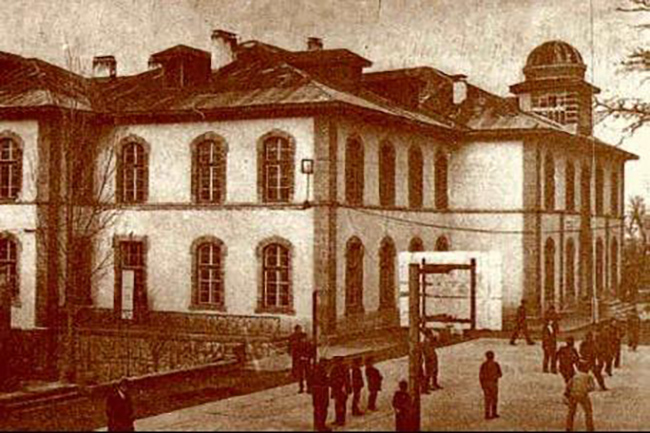
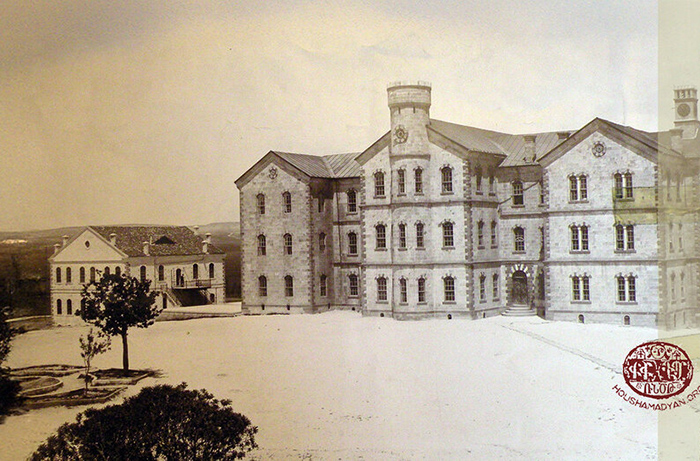
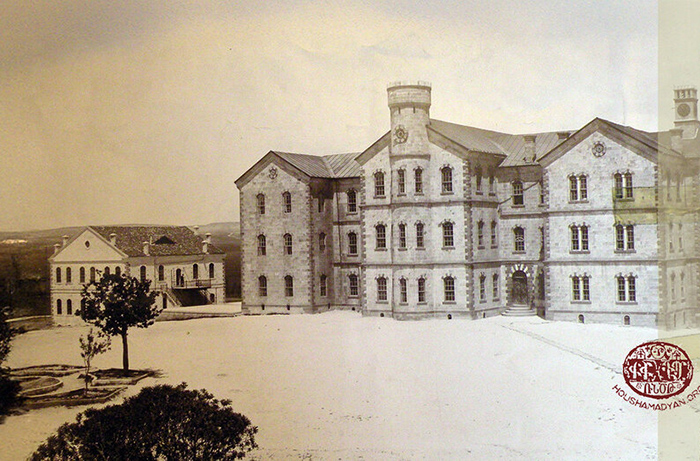
Armenian School in Aintab
The Central Turkey Armenian College in Aintab is one of the many educational institutions in Aintab. It began its regular academic operations on September 11, 1876. this institution played an important role in the history of Armenian educational institutions in the Ottoman Empire, establishing new standards in the educational sector.
Armenian Euphrates Collegein Kharpoot
Founded and directed by American missionaries and attended mostly by the Armenian community in the region. It was built in as theological seminary, then in 1878, it was renamed “Armenia College”. After 10 years, the Ottoman authorities urged to change the school’s name, which became finally “Euphrates College”, for mixed-sex students.
Euphrates College was officially closed shortly after the founding of the Republic of Turkey and nothing now remains of its buildings.
Armenia Schools in Ayntab.
There were many schools in Ayntab, The Atenagan School (Orphanage/School in 1885-86, Secondary School from 1886 to 1915), The Tankaran [Museum] Society’s Night School (1858-1867), The Lousinian School, Girls’ Schools, The Grtasirats School (1898-1915), and others.
Armenia Schools in Van
Before 1915, the city of Van was one of the most important centers for Armenian education within the Ottoman Empire like Erzurum and Istanbul. These schools employed modern educational methods. In Van there were 11 Armenian school operating in the early 1900s. Following the Armenian Genocide, most Armenian schools, and other cultural sites in Western Armenia, including Van, were destroyed, left to fall into ruin, or converted for other uses.
Armenia Schools in Cilicia
Cilicia (Adana, Ayntab, Marach, Sis, Hagen, Zeitoun,etc. had a vibrant Armenian community with a significant number of schools. In 1912, the entire Cilicia region had 176 Armenian schools with 14,285 students, making it a major center for Armenian education in the Ottoman Empire.
Armenian schools in Istanbul
The first higher education institution opened in 1838 in Üsküdar, Istanbul, on the Asian shore of the Bosphorus. By the time of Sultan Abdülmecid I in 1839, there were thirty-seven Armenian schools, including two colleges, with a total of 4,620 students in Istanbul alone.
These educational institutions played a significant role in preserving Armenian culture while also adapting to Western educational models and incorporating Ottoman state-.
During this period, notable Armenian writers and poets in Turkey included Hagop Baronian, Krikor Zohrab, Taniel Varoujan, Rupen Zartarian, Vahan Tekeyan, Yervant Odian, Levon Shant, Siamanto, Bedros Tourian, and Gostan Zarian, as well as Sibil (Zabel Asadour). The 19th century witnessed a significant literary movement that marked the emergence of modern Armenian literature. This period, known as Zartonk or the Revival period, was a time when Armenian culture thrived. The authors of this era sought to promote Armenian nationalism, and the Western variant of the Armenian language was commonly used in Istanbul. The Revivalist period came to an end between 1885 and 1890, as the Armenian people faced turbulent times. Key events during this time included the Berlin Treaty of 1878, the independence of Balkan nations like Bulgaria, and the Hamidi massacres of 1895–1896.
Destroying the Armenian Civilization
The Armenian Genocide resulted in the destruction of over two thousand years of Armenian civilization in their historic homeland of Western Armenia. The genocide also severely impacted the Armenian community in Istanbul, though the community in the capital faced a different sequence of events compared to those in the interior provinces. Most of the Armenian population in Western Armenia was systematically killed or forcibly removed through death marches and massacres. This led to the disappearance of a people who had inhabited the highlands for three millennia. Along with the people, their cultural and religious heritage was targeted. Armenian homes, businesses, churches, monasteries, schools, and historical sites were systematically destroyed, legally confiscated, or left to ruin by the Ottoman government and later the Turkish Republic. This aimed at the permanent alteration and erasure of the Armenian historical and cultural presence in the region. The pre-war Armenian population was virtually wiped off the map,.It enabled the creation of an ethnonationalist Turkish state, the Republic of Turkey.
Next: Armenians in Turkey today
YEREVAN -- The Constitutional Court rejected the applications filed by seven political forces challenging the…
WASHINGTON, DC -- the U.S. House of Representatives passed Congresswoman Laura Friedman’s (CA-30) legislation to designate the…
YEREVAN -- Ruben Rubinyan will no longer serve as Armenia’s special representative in the Armenia-Turkey…
YEREVAN -- Citizens living abroad or those who have been absent from Armenia for an…
TEHRAN -- Prime Minister Nikol Pashinyan met with Iranian President Masoud Pezeshkian in Tehran after…
YEREVAN -- Addressing the crisis that has emerged in Russia’s fuel market, Prime Minister Nikol…