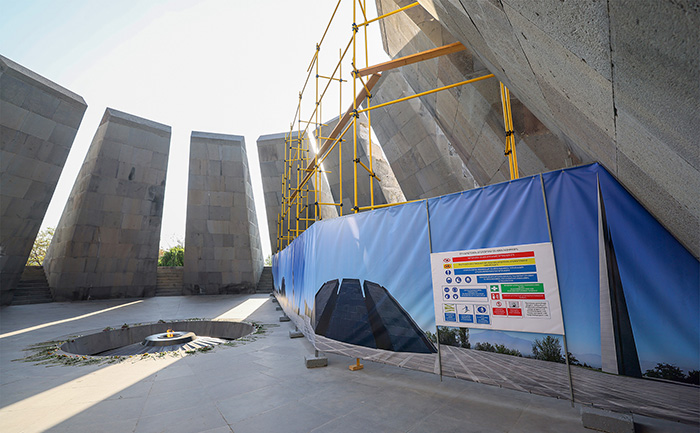
The Armenian Genocide Memorial. Photo courtesy of Shutterstock
By BEDROSS DER MATOSSIAN
In the past few weeks, a significant controversy has erupted over the renovations at the Armenian Genocide Memorial. What was initially a routine maintenance and preservation project by the Armenian Genocide Museum-Institute (AGMI) has been framed by some as a political maneuver, sparking intense debate both within Armenia and across the diaspora. Critics argue that these renovations are part of a deliberate effort to modify or even destroy the memorial, while others question the government’s true intentions. In a matter of just two weeks, the memorial—one of the most important symbols uniting Armenians globally as a testament to both suffering and resilience—has become the center of a heated political dispute.
This debate, however, obscures a far simpler reality. Dzidzernagapert, like many historical monuments, has suffered from decades of neglect. The structure and its associated museum were in urgent need of repair due to long-term exposure to the elements. The fact that the current government, whose policies on the Armenian Genocide I do not support, is managing the renovations, has led some to treat the entire project with suspicion. I have previously argued that while the Pashinyan government’s policies toward Turkey and Azerbaijan—including the controversial Washington Declaration on “peace”—may be questionable, it does not follow that every action undertaken by this administration should automatically be assumed malicious. Preservation of national heritage should not be politicized.
The Armenian Genocide Memorial was constructed in 1967 to commemorate the 50th anniversary of the genocide. Since its construction, it has never undergone a comprehensive renovation. Over decades, rain and snow infiltrated the Eternity Hall, which consists of twelve inward-leaning basalt slabs, causing severe structural damage. The absence of a proper drainage system allowed water to weaken the foundation, threatening the integrity of the monument.
The Obelisk, also built in 1967 and an integral component of the memorial, has been renovated several times, most recently during the centennial of the genocide. That renovation addressed the same issues being tackled today: water damage and structural degradation. Stones were temporarily removed, a drainage and waterproofing system was installed, and new stones were set in place. The Armenian Genocide Museum, built in 1995, and the administrative building, completed in 2015, have faced similar problems, with heavy rainfall causing water seepage and damage to ceilings and interiors.
Recognizing the urgency of these issues, the Armenian Genocide Museum-Institute (AGMI) applied to the Government of Armenia in spring 2020 for funding to address the deteriorating conditions. A team of specialists conducted a thorough inspection of the memorial and museum and concluded unequivocally that substantial renovations were necessary. Based on these findings, AGMI formally requested state funding for the works. The drafting of renovation plans was entrusted to Haynaxagits company, with Sashur Kalashyan, one of the original architects of the memorial, overseeing both the planning and execution phases.
Following the preparation of draft plans and a preliminary budget, the Ministry of Education, Science, Culture, and Sports announced a public tender in accordance with the RA Law on Procurement. Only one company submitted a bid, winning the contract. A separate company was appointed to oversee technical control, while Haynaxagits, under Kalashyan’s direct supervision, conducted the author’s supervision to ensure fidelity to the original design and historical accuracy.
The renovation project includes several critical interventions designed to ensure the long-term preservation and integrity of the Armenian Genocide Memorial and its surrounding facilities:
Tragically, what should have been a technical and preservation-focused project to safeguard one of the most sacred sites for Armenians has been politicized. Work on the memorial began in October of the previous year, and the renovation of the slabs had been ongoing for two months when an unprecedented campaign against the project began, casting suspicion on the motives behind routine repairs.
Rather than succumbing to conspiracy theories, individuals and the public should approach these renovations with critical thinking and an informed perspective. It is crucial to differentiate between legitimate preservation work and politically motivated narratives. The media, particularly in Armenia, also bears a responsibility to provide unbiased, fact-based reporting rather than amplifying polarization. Unfortunately, media sensationalism has obscured the realities of the renovations, draining resources, energy, and valuable time from AGMI staff, whose efforts could have been dedicated to research, exhibitions, and educational programs that serve both Armenians and the international community.
Preserving Dzidzernagapert is not just about maintaining a physical structure; it is about safeguarding a symbol of memory, resilience, and historical truth for future generations. Renovation and restoration are acts of respect and remembrance, not political statements, and should be understood as such by both the public and the media.
Bedross Der Matossian is Professor of Modern Middle East History and the Hymen Rosenberg Professor in Judaic Studies at the University of Nebraska–Lincoln, USA. He is the author, editor, and co-editor of seven books, including Shattered Dreams of Revolution: From Liberty to Violence in the Late Ottoman Empire (2014) and The Horrors of Adana: Revolution and Violence in the Early Twentieth Century (2022). His most recent edited volume, Denial of Genocides in the Twenty-First Century, was published by the University of Nebraska Press in 2023.
By KRIKOR KOHODANIAN The parliamentary election campaign in Armenia, scheduled for June 7, is drawing…
WASHINGTON, DC -- The United States supports “Armenia’s sovereignty, territorial integrity, and independence, including Armenia’s…
LONDON/NEW YORK—Bloomsbury Press has announced the publication of the late Dr. Garabet K. Moumdjian’s The Armenian…
YEREVAN -- The construction of a major artificial intelligence (AI) center in the city of…
On June 7, your vote is not merely an election choice; it will determine Armenia’s…
ATLANTA -- According to an exclusive CNN investigation, Israel secretly deployed special military and intelligence…