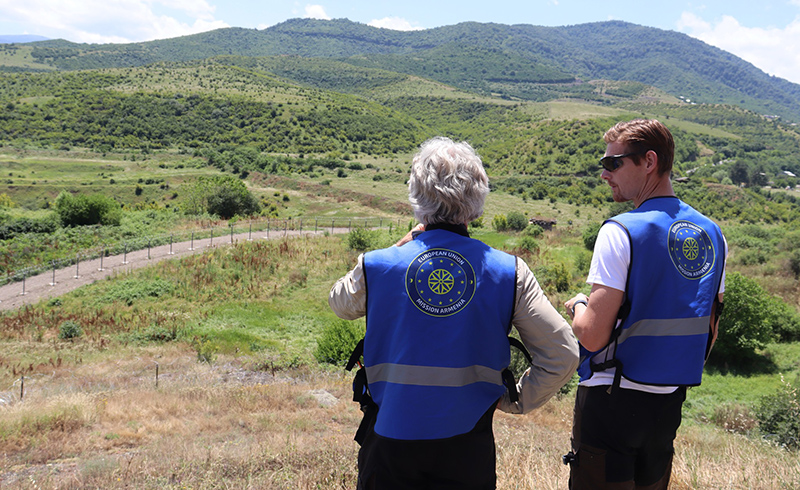
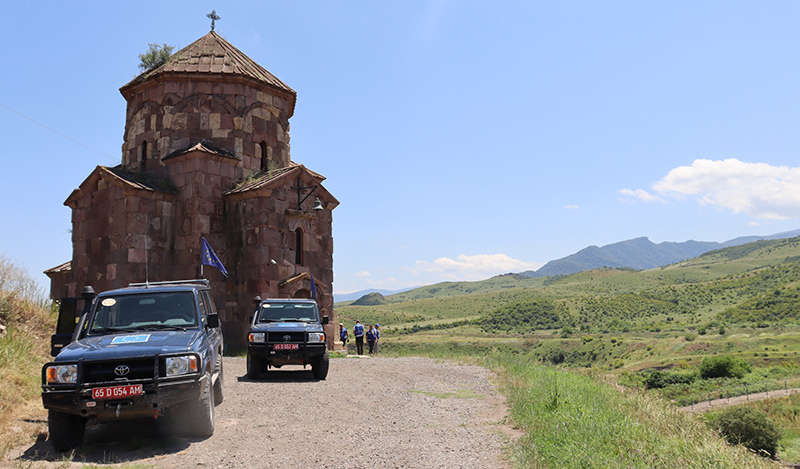
YEREVAN — Representatives of the EU Monitoring Mission have worked in various countries under different mandates, but they have never encountered the same level of hospitality and reception as they have in Armenia. This positive environment greatly encourages their effective work, said Markus Ritter, Head of the EU Monitoring Mission in Armenia, during a meeting with delegates of the Armenian-Georgian conference in Ijevan.
“The mission began its activities in February 2023, at a time when Azerbaijani forces had already advanced into certain territories of Armenia. We conduct observations along the Armenia-Azerbaijan border. Our goal is to contribute to regional peace and stability by helping prevent tensions along the border with Azerbaijan. We frequently visit border communities that have been affected to some degree by the conflict. Through our presence, we aim to create a secure environment and instill confidence among residents of those communities,” Ritter said.
He noted that the mission currently operates out of six main field offices, stretching from Kapan to Ijevan, with its headquarters located in Yeghegnadzor. According to Ritter, the mission should not be based in Yerevan since its main work takes place along the Armenia-Azerbaijan state border. Observations are conducted along nearly 1,000 kilometers of border. The mission employs 225 staff members, including 166 international observers from 25 EU member states, with the rest being local employees.
Ritter recalled that when the mission launched, the EU had assumed a mediating role in resolving the conflict and normalizing relations between Armenia and Azerbaijan. European Council President Charles Michel, French President Emmanuel Macron, and later German Chancellor Olaf Scholz all took direct steps to support the peace process. Today, direct dialogue is ongoing between Armenia and Azerbaijan.
“Since the beginning of our mission, the number of border incidents has significantly decreased, and tensions have eased considerably. Occasionally, isolated gunfire is heard, but fortunately, there have been no casualties or injuries. For instance, two years ago, Armenia’s Foreign Ministry asked us to monitor a section near the village of Khachik after reports emerged that Azerbaijani soldiers were shooting from Nakhichevan at Armenian farmers, disrupting agricultural work. But when we began visible monitoring in that area, the gunfire stopped. Neighboring countries have come to recognize that the EU Monitoring Mission in Armenia has become a stabilizing factor,” Ritter stated.
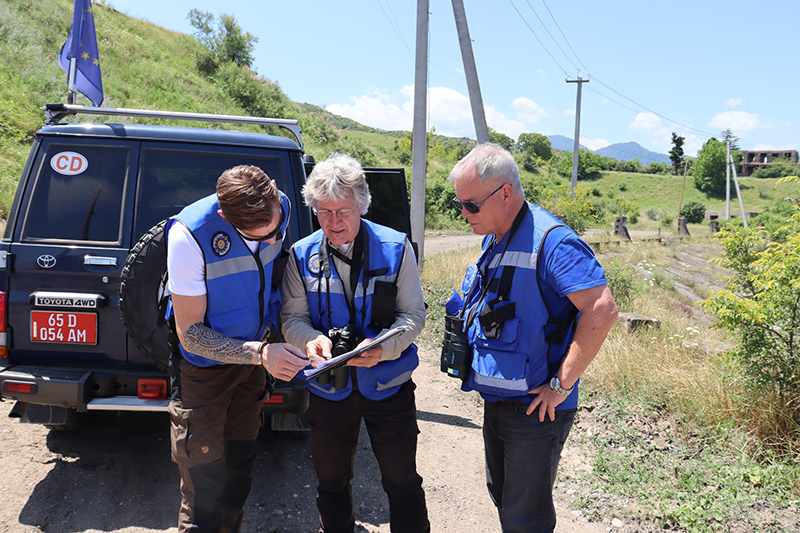
He added that the mission conducts comprehensive research along the border, gathering facts and sending detailed reports to Brussels to inform political decision-makers. These reports help EU representatives draw appropriate conclusions and develop a clear understanding of the situation along the entire Armenia-Azerbaijan border. The mission does not share these reports with either of the conflicting parties. Observations are conducted both with escorts and independently.
“At first, we were accompanied because we were unfamiliar with the terrain. But a year and a half later, we’ve conducted over 5,500 observations, which shows that our European observers now know where to go and what to do. Over time, we reduced the number of escorts—especially military ones—because if the mission is to remain impartial, we cannot appear to be aligned with one side by using its military. We now seek their assistance only in extreme cases. We also share our monitoring plans with Baku via the EU Special Representative for the South Caucasus based in Tbilisi. We do not seek permission or wait for a response—we simply notify both sides of our movements to ensure transparency,” Ritter explained.
He emphasized that the mission operates freely across Armenia, including in border communities, without any restrictions. Since last year, the team has also made regular visits to educational institutions, informing students about the mission’s work, mandate, and the goals of the European Union.
“When we arrived in Armenia, there were high expectations surrounding our presence. Many believed we were here as a replacement for Russian peacekeepers or that we were EU military forces deployed to defend Armenia against possible attacks. But we had to explain that we are an entirely civilian, unarmed mission. Our role is to report the situation to our superiors—not to defend the residents of border communities,” Ritter clarified.
Thanks to local media, he added, people now understand the true nature of the mission. They know the observers only use binoculars and cameras. The EU Monitoring Mission is the only international organization with access to remote locations typically occupied only by military personnel and where civilians do not live. In all border communities, Ritter and his team are recognized and warmly welcomed. Locals often invite the observers into their homes.
“During our mission, various rumors have circulated about us. Azerbaijan refuses to cooperate with us, demands our withdrawal, and accuses us of espionage. However, none of this reflects reality. We are not an intelligence agency. Our only goal is to prevent escalation in the South Caucasus and support Armenia so that it enters negotiations from a stronger position—because talks are more productive when there is no shooting,” Ritter concluded.
YEREVAN -- President Vahagn Khachaturyan has signed a decree appointing Nikol Pashinyan prime minister of…
YEREVAN -- Armenia’s ninth National Assembly, formed following the June 7 elections, began its work…
By KRIKOR KHODANIAN The Israeli government has once again used recognition of the Armenian Genocide…
YEREVAN -- Armenian Foreign Minister Ararat Mirzoyan and Iranian Deputy Foreign Minister for Economic Diplomacy…
YEREVAN -- The shares of the Yerevan Ararat Brandy-Wine-Vodka Factory, owned by businessman Gagik Tsarukyan,…
MOSCOW -- Russian Economic Development Minister Maxim Reshetnikov has emphasized what he described as the…