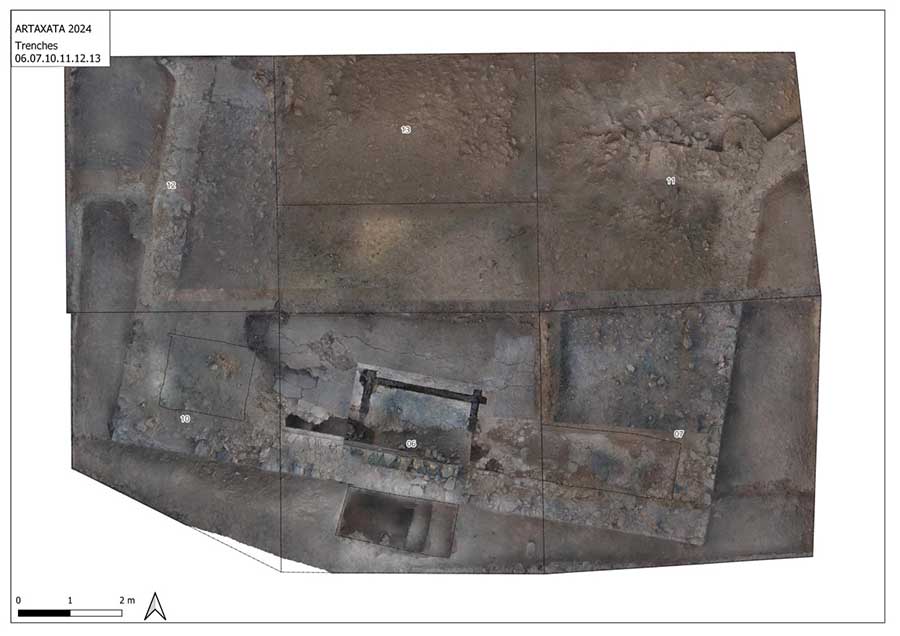
Archaeologists from the National Academy of Sciences of Armenia and the University of Münster in Germany, have discovered the remains of a previously unknown early Christian church in the ancient city of Artaxata (Ardashad). The find consists of an octagonal building with cruciform extensions. The team excavated parts of the church and studied it using geophysical methods. “The 4th century building is the oldest archaeologically documented church in the country – sensational evidence for early Christianity in Armenia,” remarked Professor Achim Lichtenberger of the University of Münster. “Octagonal churches were unknown here until now, but we are very familiar with them from the Eastern Mediterranean region, where they first appeared in the 4th century AD,” added Dr Mkrtich H. Zardaryan of the National Academy of Sciences of Armenia.
Typologically, the find corresponds to early Christian memorial buildings. In the cross-shaped extensions, the researchers discovered the remains of wooden platforms, which were radiocarbon dated to the mid-4th century AD. The octagonal building, around 30 metres in diameter, had a simple mortar floor and terracotta tiles. Finds of marble indicate that it was lavishly decorated with this material imported from the Mediterranean. The German-Armenian team has been in Armenia since September. They will continue their excavations and hope to make new discoveries, including the question of to whom the church was dedicated.
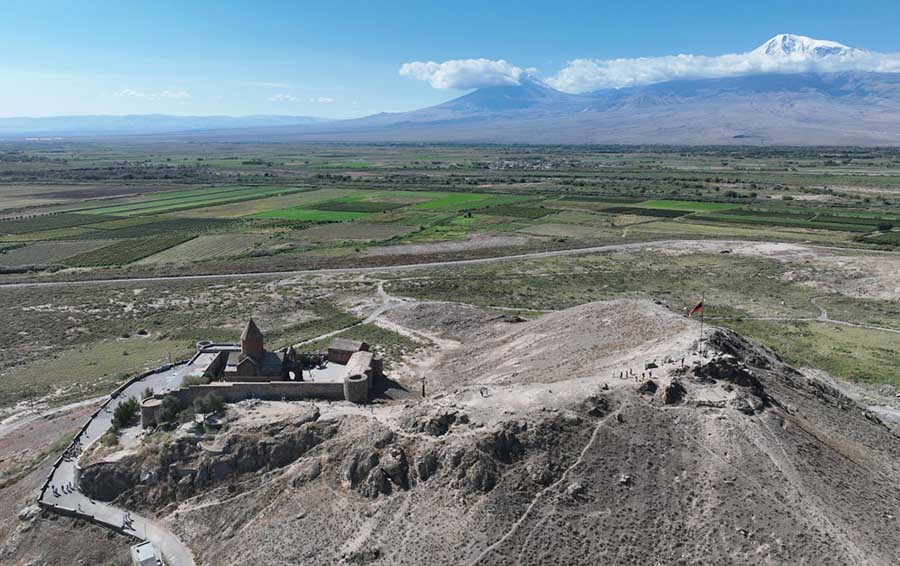
Gregory the Illuminator converted the Armenian king Tiridates III to Christianity in Artaxata in 301 AD, making Armenia the first Christian state in the world. The medieval monastery of Khor Virap, just a stone’s throw from the now-discovered church, is a reminder of this tradition. Artaxata served as the capital of the Kingdom of Armenia, ruled by the Artaxiad and Arsacid (Arshaguni) dynasties. The city developed into an important metropolis in the Hellenistic period and was the capital of the Kingdom of Armenia for almost six centuries.
The Armenian-German research team has been exploring the Hellenistic metropolis of Artaxata in the Ararat Plain since 2018. The excavation project on the settlement archaeology of the ancient city is funded by the German Research Foundation (DFG) and the National Academy of Sciences of Armenia.
YEREVAN -- Armenia is undergoing a significant transformation in its migration patterns, shifting from a…
WATERTOWN, MA--The Armenian Museum of America (AMoA) is pleased to announce the appointment of Sarah…
WASHINGTON, DC -- A delegation from Armenia's Ministry of Defense, headed by Deputy Defense Minister…
YEREVAN -- More than 45,000 Armenians displaced from Artsakh (Nagorno-Karabakh) have been granted citizenship of…
BEIRUT -- Haigazian University commemorated its annual Founders’ Day on Monday, October 12, 2026, with…
LUXEMBOURG -- The European Union has assisted Armenia in countering foreign interference ahead of the…