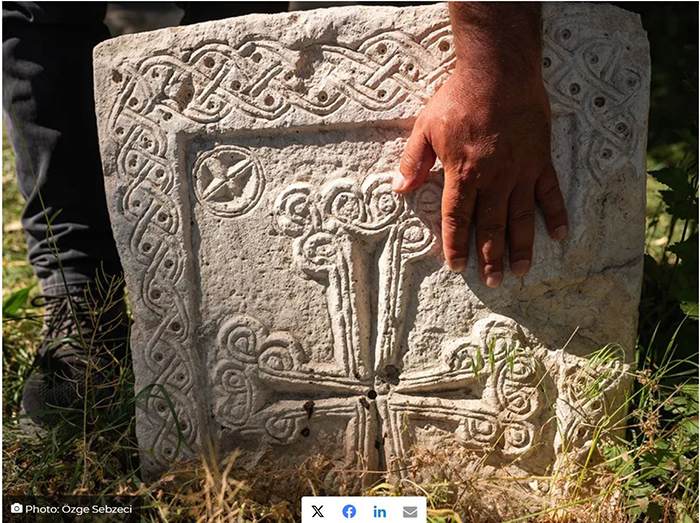
The vast majority of treasure hunters in Turkey are looking for treasure they believe was left behind by Armenians, The Economist writes.
In a length article author Erin O’Brien explores the destruction the hunt for the buried treasure of the Armenians has caused.
“Racist stereotypes in Turkey had often depicted Armenians as rapacious hoarders (ignoring the fact that many were very poor). It didn’t take long for people to speculate that Armenians fleeing the genocide had buried their valuables, in the hope that they would one day return,” he writes.
The author notes that sometimes the pursuit of riches is harmless, but adds that the frenzied digging taking place in Armenian churches and graveyards is destroying the country’s historical fabric. Artefacts are siphoned off to private dealers, and the hunters’ crude methods cause irrevocable damage to archaeological sites.
According to him, the government of President Recip Tayyip Erdogan has largely neglected the plundering of regions formerly inhabited by Armenians.
These days, most treasure hunts begin on social media. “Countless treasure maps supposedly drawn by Armenians circulate online, the vast majority of which are amateurish fakes, with notes written anachronistically in modern Turkish. The business is rife with scammers. People purporting to be imams or Armenian priests will perform – for a price – rituals they promise will reveal the location of treasure. Another common tactic involves drawing a fake map showing a cache buried on a rich person’s property. The con artist produces a coin he claims to have found there, and convinces the landowner to pay him to conduct further excavations. Then he absconds with the money,” O’Brien writes.
He noted that many antiquities trafficked by Turkish dealers find their way out of the country. Some are hidden in shipping containers holding commercial goods and are labelled as something innocuous, like “appliance.”
“Once, there were more than 600 churches around Lake Van. Now, fewer than 100 are left. Those that remain standing look like skeletons, their interiors pillaged by treasure hunters. Armenian engravings have been gouged out, and domes and columns have collapsed into piles of rubble,” O’Brien writes.
By BERGE JOLOLIAN Armenia cannot choose its neighbors. But must its neighbors—and more distant powers—be…
YEREVAN — Armenian Minister of Economy Gevorg Papoyan attended the opening ceremony of TOON EXPO…
YEREVAN — European Union Ambassador to Armenia Vassilis Maragos and Edvard Petrosyan, Director of Armenia’s…
YEREVAN — The Central Bank of Armenia has announced the release of a new silver…
DUBLIN — Armenian Prime Minister Nikol Pashinyan visited the Institute of International and European Affairs…
DUBLIN — Leaders from nine European countries and the European Union have reaffirmed their support…