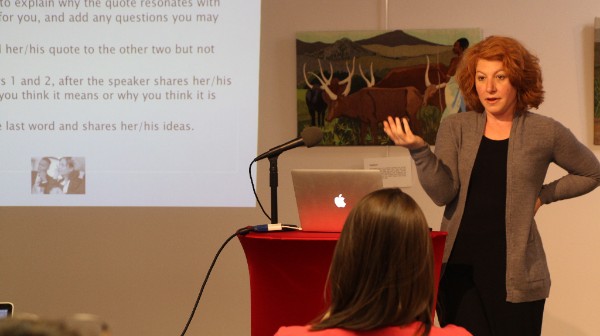
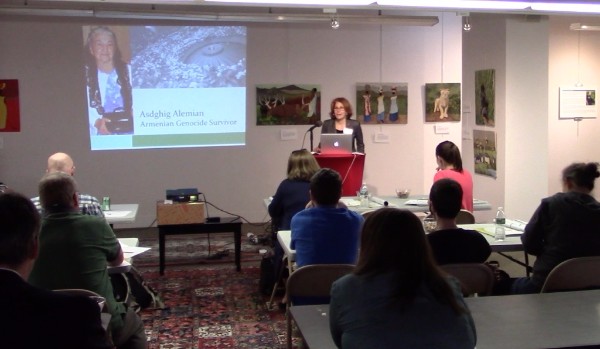
WATERTOWN, MA – The Genocide Education Project (GenEd) provided a full-day workshop on teaching about the Armenian Genocide for Boston-area History and English teachers on June 10th.
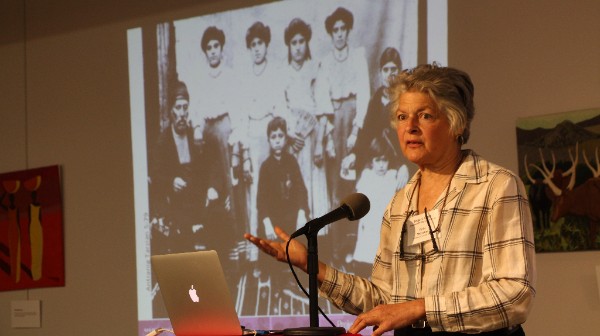
Held at the Armenian Library and Museum of America, the training covered historical context as well as various approaches to teaching the subject, including the use of survivor testimony, photographs, documentary film, book reading assignments, and persuasive composition. Teachers also met a local 106-year old Armenian Genocide survivor and were given a tour of the museum and library, and provided a traditional Armenian luncheon.
“I have been teaching for over 25 years and I have been to a lot of conferences, and this was by far one of the best. The survivor presentation was incredible as were the other speakers and many resources,” said Joanna Honig, Watertown High School English teacher.
Co-hosted by Armenian Library and Museum of America, the National Association for Armenian Studies and Research, Watertown and Boston Public Schools, and Project Save, and with the participation of the USC Shoah Foundation, the free workshop also provided numerous instructional materials, including a variety of lesson plans and a classroom poster and guidance through the downloadable resources, an online interactive lesson, and classroom videos accessible through GenEd’s website.
Dr. Dikran Kaligian, historian and GenEd Board member, provided the historical and political context, timeline, and methodology of the Armenian Genocide, as well as the U.S. humanitarian response, and the government of Turkey’s denial of event and its ramifications on education, international affairs, and US policy.
Asdghig was later sent to another Turkish home in Aleppo. Asdghig told the workshop teachers of the anguish she felt when separated from her sister. Her sister escaped and the two were rescued, spending several years at Aleppo’s Evangelical Armenian orphanage, before relocating to their uncle’s home in Massachusetts. Asdghig married another Genocide survivor from Keghi and together they ran a grocery and raised a family.
“It was a great privilege for me to learn about Asdghig’s extraordinary life and introduce her to the educators, to allow us all the benefit of her life experience and inner strength,” said Makasdjian.
Marc Mamigonian, Director of Academic Affairs at the National Association for Armenian Studies and Research focused on how novels and memoirs about the Armenian Genocide are valuable resources for English Language Arts and Humanities courses. Highlighting the books Forgotten Fire, Black Dog of Fate, Goodbye Antoura, and My Name is Aram, Mamigonian described their value both as good literature and as historical instruction.
By KRIKOR KHODANIAN The 23rd Congress of the Social Democratic Hunchakian Party (SDHP) was recently…
By BERGE JOLOLIAN When doctors in Kyrgyzstan wanted help treating children at risk of blindness,…
Tekeyan Cultural Association Pasadena–Glendale Chapter and Armenian Art Gallery Present a Collective Exhibition of Contemporary…
TURKMENBASHI - Armenian Prime Minister Nikol Pashinyan has declared that peace between Armenia and Azerbaijan…
TURKMENBASHI - - Armenian Prime Minister Nikol Pashinyan and Iranian President Masoud Pezeshkian met in…
STRASBOURG -- The European Parliament has adopted a resolution calling on Azerbaijan to immediately release…