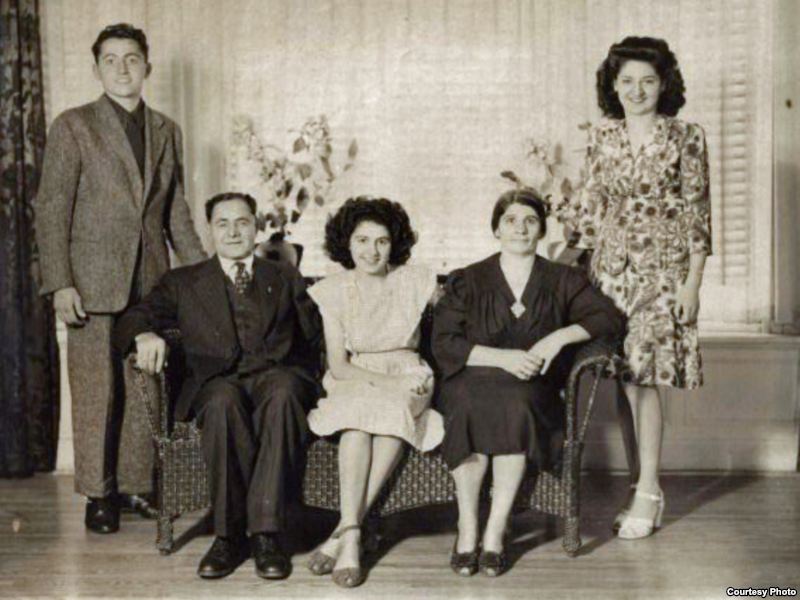
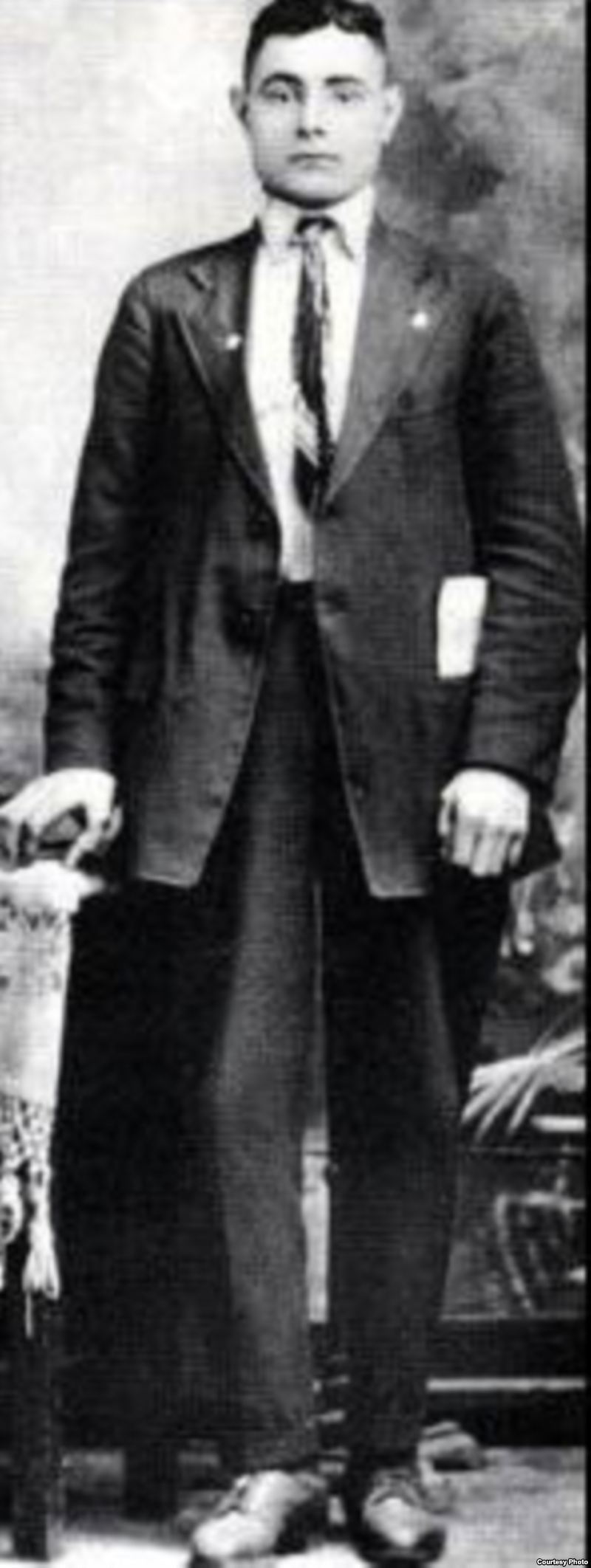
Armenian \"Titanic\" survivor Neshan Krekorian (seated left) with his wife, Persape (seated right), daughter Angie (center), son George (left), and daughter Alice (right).
Neshan Krekorian was barely in his twenties when his father urged him to emigrate from western Armenia and start a new life far away across the Atlantic Ocean.
Thousands of Armenians were doing the same, in a bid to escape rising violence and persecution at the hands of Ottoman-era Turks.
So Krekorian fled, making his way across Europe and purchasing a third-class ticket for what would prove a fateful ocean journey.
“His father told him to leave the country and seek a new life in Canada and hopefully bring his brothers over,” says Krekorian’s grandson, Van Solomonian.
“He had two younger brothers who stayed behind. My grandfather gathered four other compatriots from Turkish Armenia in the area that he lived in, which was Keghi. And they got to France in Cherbourg, and by pure fate got on the ‘Titanic.'”
Krekorian was one of over 700 third-class passengers on board the maiden voyage of the celebrated ocean liner.
Immigrants from across the British Isles, Scandinavia, Eastern Europe, and the Middle East paid the equivalent of $1,000 for a steerage-class ticket entitling them to modest sleeping quarters and meals in the third-class dining hall for the duration of what was meant to be a weeklong voyage.
‘A Shudder And A Dull Thud’
Solomonian remembers his grandfather describing the quarters as cramped, but comfortable. Krekorian rarely spoke of the ‘Titanic.’
But things took a turn for the worse five nights into the journey. Close to midnight on April 14, the ship hit a massive iceberg in the North Atlantic and slowly began to sink. According to Solomonian, his grandfather and some of his fellow third-class passengers had just settled in for a game of cards when they heard “a shudder” and “a dull thud.”
“He knew something had happened, but he didn’t quite know what,” Solomonian says. “The problem with the third-class passengers was that they were actually locked down on their decks, because at the time regulations required that steerage passengers be isolated from first and second class.
“He and a few other men had to break a chain lock to get up to the upper decks. My grandfather ended up on boat 10. The boat was being lowered and he literally just jumped over the side and basically got away with it.”
Many steerage-class passengers were not nearly so lucky. More than two-thirds of the third-class ticket holders went down with the ship, many because they were unable to reach the upper decks.
Of the approximately 2,200 people on board, only 700 survived, most of them first- and second-class travelers.
Krekorian eventually made his way to Canada, ultimately settling in the town of St. Catherines in Ontario.
He Never Forgot The Horror
A foundry worker in the local General Motors plant, he earned enough money to honor his father’s wish to bring his younger brothers to Canada, and helped found the town’s Armenian Church, the first of its kind in the country.Neshan Krekorian’s final resting place in St. Catharines, Ontario
Solomonian says it’s possible his grandfather’s brothers only learned of his ordeal on the “Titanic” once they had arrived in Canada.
When Krekorian died, at the age of 89, one of his brothers lingered at his tombstone, whispering his gratitude for Neshan’s help in getting them out of Keghi.
Solomonian, who grew up in St. Catherines and now lives in Toronto, remembers his grandfather as a quiet man who spoke little English and frequently clutched a string of traditional Armenian worry beads.
Krekorian rarely spoke of his experiences on the ill-fated “Titanic.” Solomonian recalls hearing only brief snippets of his grandfather’s memories of desperate passengers screaming for help and plunging to their death in the icy waters. But he is certain Krekorian never forgot the horror of that day:
“He never went on a boat again in his life,” he says. “He wouldn’t swim. In St. Catherines they had a nice beach on Lake Ontario, and when the family would go there for Sunday picnics, he would never, ever go in. I guess that speaks to the trauma that he experienced. He never got over that fear.”
YEREVAN -- Ruben Rubinyan of the Civil Contract Party has been elected speaker of Armenia’s…
YEREVAN -- By decree of President Vahagn Khachaturyan, Mher Grigoryan and Tigran Khachatryan have been…
JERUSALEM -- Six Jewish individuals attacked the entrance of the St. James Monastery in Jerusalem’s…
YEREVAN -- Efforts to secure the return of Armenian prisoners held in Azerbaijan are carried…
ETCHMIADZIN -- His Holiness Karekin II, Catholicos of All Armenians, received lawmakers from the Strong…
ROCHESTER, NY – Award-winning pianist Dr. Laura Farré Rozada invites audiences to discover an extraordinary…