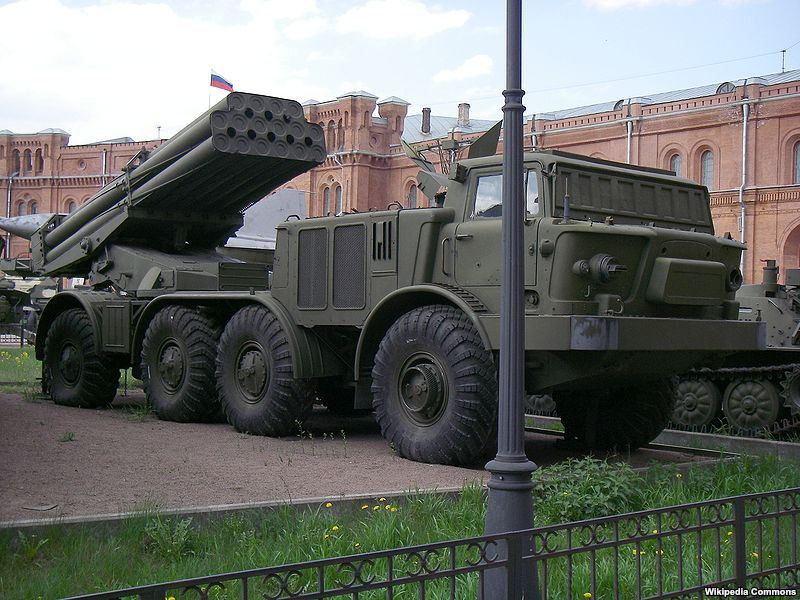
According to Moldovan media, the secret deal was formalized this summer through a Latvian intermediary firm, Latspetsexport. The government of Moldova has essentially confirmed that information after it sparked a political scandal in the former Soviet republic later in September.
The Moldovan news agency Omega last week claimed to have obtained copies of the Chisinau government’s contracts with Latspetsexport worth $3.3 million. It said they envisage the sale of several types of Soviet-made anti-tank and other rocket systems along with thousands pieces of ammunition used by them.
Those allegedly included a dozen BM-27 Uragan (Hurricane) multiple-launch rocket systems that have a firing range of up to 35 kilometers. “According to authorities in Moldova, some of these weapons have already been shipped to Armenia,” reported Omega.
Official Yerevan has declined to deny or confirm the reports. “In the interests of national security, details regarding the quantity and types of weapons and the party selling them are not subject to publication,” Davit Karapetian, the Armenian Defense Ministry spokesman, said on September 23.
The Azerbaijani government reacted negatively to the reported arms deliveries, expressing serious concern, saying that it will complicate a peaceful resolution of the Nagorno-Karabakh conflict.
Elnur Aslanov, head of an analytical unit at Ilham Aliyev’s administration, on Friday described this and other arms acquisitions by Yerevan as a “serious destabilizing factor” in the region.
“The policy on Nagorno-Karabakh pursued by Armenia testifies to the destructive position of that state in the region,” Russian and Azerbaijani news agencies quoted him as telling journalists in Baku. “Any arms acquisition, any increase in the number of weapons in the region certainly does not lay the groundwork for establishing peace and stability and, on the contrary, impedes that.”
Armenia’s Deputy Foreign Minister Shavarsh Kocharian dismissed the Azerbaijani protests as “aggressive whining” on Friday. “And this is natural because Baku has to explain to its own people where the billions [of dollars,] which are constantly trumpeted about from various podiums and supposed to be spent on military procurements, have ended up and why its policy of military blackmail in [peace] negotiations has failed,” Kocharian said in a statement.
YEREVAN — The Armenian Genocide Museum-Institute will host an international academic conference on November 27,…
YEREVAN — The continued management of Armenia’s railway network under a Russian concession agreement will…
Dell Technologies founder and CEO Michael Dell has highlighted the expansion of cooperation with Armenia,…
KEHL, GERMANY — Five members of an Armenian family were found dead in an apartment…
FRESNO -- Author and photographer Hrair Hawk Khatcherian will present a talk on his new…
LONDON — Renowned Armenian marine painter Hovhannes Aivazovsky’s Venice at Night: San Giorgio Maggiore has…