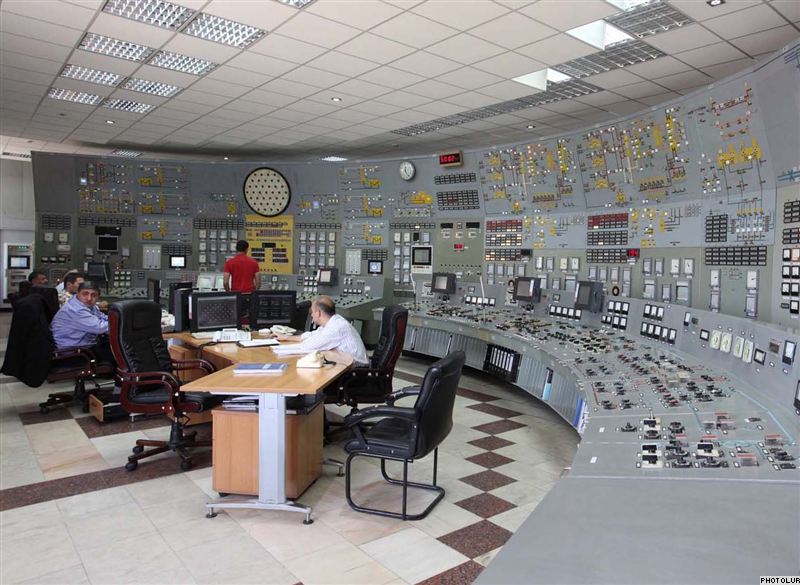
While identifying several “good plant practices” at the Soviet-era facility, the experts working under the aegis of the International Atomic Energy Agency (IAEA) recommended specific measures which they said would further boost its operational safety.
“There is no industrial activity that does not pose any risk, but I think the results of our inspection show that this risk [at Metsamor] is acceptable,” Gabor Vamos, head of the IAEA’s ad hoc Operational Safety Review Team (OSART) for Armenia, told a news conference in Yerevan.
The Armenian government solicited the OSART mission about two months ago, citing the need to learn lessons from the grave accidents at Japan’s Fukushima Daiichi nuclear plant. It also hoped to ally renewed domestic and international concerns about Metsamor’s safety.
Like Japan, Armenia is situated in a seismically active region prone to powerful earthquakes. Local environment protection groups say the Fukushima disaster should be a wake-up to the authorities in Yerevan to shut down the Metsamor plant as soon as possible.
Armenian government officials and nuclear experts dismiss such concerns. One of their arguments is that the plant has undergone numerous safety upgrades since one of its two reactors was reactivated in 1995.
The OSART mission that arrived in the country on May 15 comprised 11 experts representing the IAEA, the European Union, as well as eight individual countries, including the United States, Britain and France. They spent two weeks inspecting Metsamor’s reactor and other facilities, assessing the plant’s safety and maintenance procedures and interviewing its personnel.
Vamos, who is from Hungary, said his team has submitted its preliminary findings to the Armenian government and will release a final report within three months. He said they contain three dozen proposals and recommendations and seven “good plant practices” that will be recommended to the nuclear industries of other nations for consideration.
According to Vamos, one of those examples is the fact that the Metsamor staff take wide-ranging safety measures on their own without relying on private contractors, as is the case in many nuclear plants.
The IAEA stressed this fact in a separate statement issued on Thursday. “This unique approach resulted in staff acquiring deep knowledge and skills to successfully operate and maintain new equipment,” it said.
The statement also said, “The plant has developed a specific, comprehensive system supported by procedure to mitigate the consequences of a station blackout by providing power to systems and components necessary for cooling the reactor in emergency conditions.”
On the downside, Vamos noted that Metsamor technicians do not quickly identify all equipment deficiencies that require urgent repairs. The Armenian authorities should work out a more rigorous mechanism for keeping the plant’s equipment in an “ideal state,” he said.
“The [Metsamor] administration expressed a determination to address all the areas identified for improvement and requested the IAEA to schedule a follow-up mission in approximately 18 months,” read the IAEA statement.
The Vienna-based nuclear watchdog also stressed that the OSART mission to Armenia was not a full-fledged “regulatory inspection.” “Nor is it a design review or a substitute for an exhaustive assessment of the plant’s overall safety status,” it said.
Metsamor’s sole functioning reactor generates about 40 percent of the country’s electricity. The EU classified VVER 440-V230 light-water reactor in the 1990s as one of the “oldest and least reliable” of 66 such facilities built in the former Soviet Union and Eastern Europe.
TURKMENBASHI - Armenian Prime Minister Nikol Pashinyan has declared that peace between Armenia and Azerbaijan…
TURKMENBASHI - - Armenian Prime Minister Nikol Pashinyan and Iranian President Masoud Pezeshkian met in…
STRASBOURG -- The European Parliament has adopted a resolution calling on Azerbaijan to immediately release…
YEREVAN -- The Armenian National Assembly has announced the composition of a parliamentary commission established…
YEREVAN -- Armenia's Prosecutor's Office has submitted an indictment against former Police Troops Commander Grigor…
YEREVAN -- Samvel Karapetyan, leader of the opposition Strong Armenia Party, has reiterated his determination…